Food & Drink
How to roast a chicken: juicy meat, crisp skin, safely cooked
How to roast a chicken with crisp skin and juicy meat: preparation, oven temperature, timings by weight, checking doneness with a thermometer, resting and carving.
 Bitezine Editorial TeamRankings, reviews & guides 5 min read
 AI generated
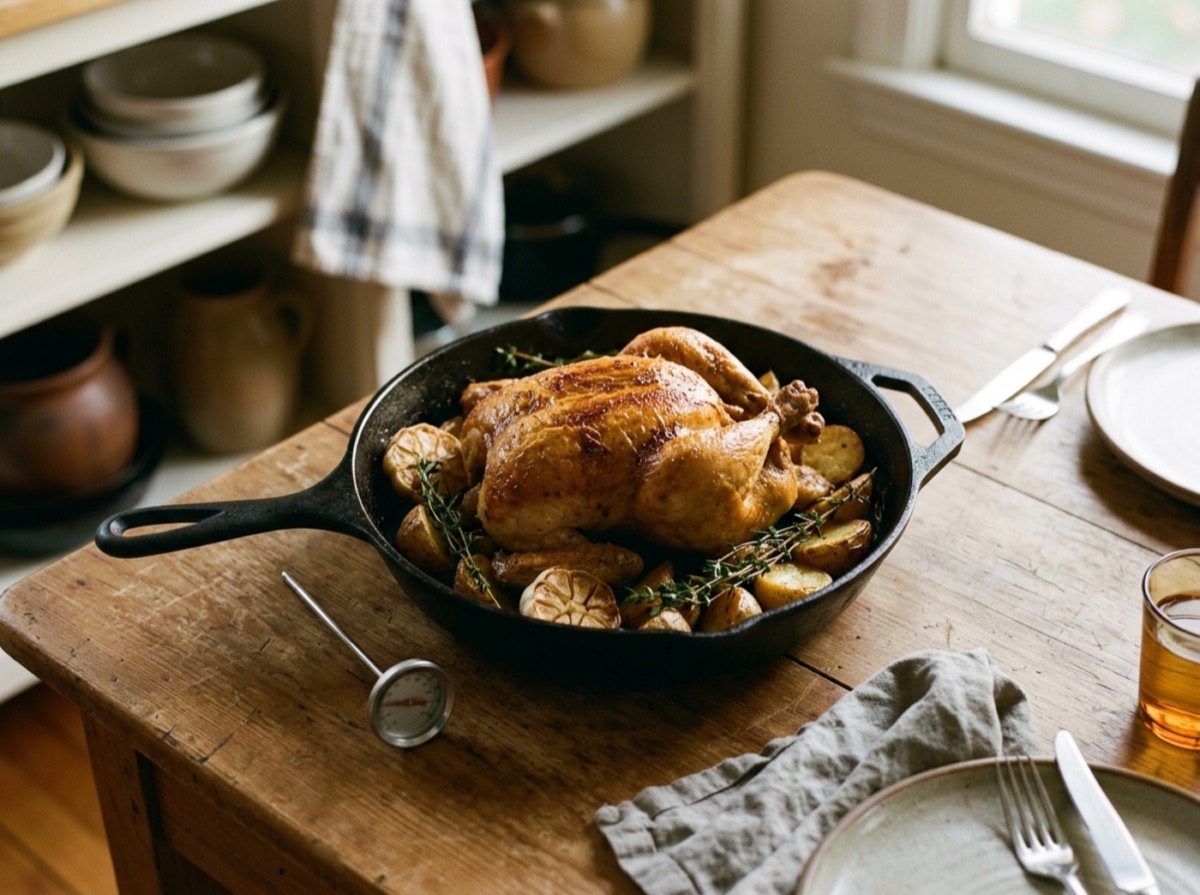
Knowing how to roast a chicken is one of the most useful skills in any kitchen. A whole bird feeds a family, costs less per portion than individual cuts and leaves bones for stock. The goal is simple: crisp, golden skin, moist meat and a chicken that is fully and safely cooked.
This guide covers choosing and preparing the bird, oven temperature and timings, how to check doneness properly, resting, carving and storing leftovers.
What you need to roast a whole chicken
A chicken of about 1.5 to 2 kg feeds four people. Beyond the bird, you need very little: salt, pepper, a little butter or oil, and a roasting tin or ovenproof pan. A lemon, a halved head of garlic and a few sprigs of thyme or rosemary add flavour from inside the cavity.
The most valuable tool is a digital meat thermometer. It removes the guesswork, and it is the most reliable way to know that chicken is both safe and not overcooked.
Should you wash raw chicken?
No. Food safety agencies including the US Centers for Disease Control and Prevention advise against washing raw chicken. Rinsing does not remove bacteria such as Campylobacter and Salmonella; it splashes them onto the sink, counter and nearby food. Cooking the bird thoroughly is what makes it safe.
Take the chicken out of its packaging over the tin, pat it dry with kitchen paper and throw the paper away. Wash your hands, and any board or knife that touched the raw bird, with hot soapy water before handling anything else.
Dry skin browns; wet skin steams.
How to prepare the chicken for crispy skin
Dry skin browns; wet skin steams. For the crispiest result, dry-brine the chicken: pat it dry, season it all over with salt and leave it uncovered on a plate in the bottom of the fridge for several hours or overnight. The salt seasons the meat and the fridge air dries the skin. Keep it away from ready-to-eat foods.
Take the chicken out of the fridge about 30 minutes before cooking. Rub the skin with soft butter or oil and season with pepper. Put the lemon, garlic and herbs loosely inside the cavity. Many food safety bodies recommend cooking stuffing separately in a dish, because a tightly stuffed bird cooks unevenly and the stuffing may not get hot enough.
What temperature and how long to roast a chicken
Roast in a preheated oven at about 200°C, or 180°C for a fan oven. A common rule of thumb is 20 minutes per 500 g plus an extra 20 minutes, which puts a 1.5 kg chicken at about 1 hour 20 minutes. Treat that as an estimate: ovens and birds vary, so use a thermometer to decide when it is done.
Place the chicken breast-side up. Some cooks start it on a bed of sliced onions or root vegetables, which lifts it off the base and flavours the pan juices. Baste once or twice with the juices if you like, but do not open the oven too often.
- 1.2 kg chicken: roughly 1 hour 10 minutes
- 1.5 kg chicken: roughly 1 hour 20 minutes
- 1.8 kg chicken: roughly 1 hour 30 minutes
- 2 kg chicken: roughly 1 hour 40 minutes
How to tell if roast chicken is cooked
Chicken must be cooked all the way through, because bacteria can be present throughout the meat. Push the thermometer into the thickest part of the thigh, without touching the bone. US guidance from the CDC and USDA is a minimum of 74°C (165°F). UK guidance is that the centre should reach 70°C and stay there for two minutes, or reach a higher temperature for a shorter time.
Without a thermometer, pierce the thickest part of the thigh: the juices should run clear with no pink, and the meat should not be pink when cut. A leg that wiggles loosely in its joint is another sign. These checks are less precise, which is why a thermometer is worth having.
Why you should rest roast chicken
Move the chicken to a board, cover it loosely with foil and rest it for 10 to 20 minutes. The temperature inside keeps rising a little as it rests, and the juices settle back into the meat instead of pouring out when you carve. Use the time to make gravy from the pan juices or finish the vegetables.
How to carve a roast chicken
A sharp knife and a steady board make carving easy.
- Cut through the skin between the leg and body, pull the leg away and cut through the joint.
- Separate each leg into thigh and drumstick at the joint.
- Pull the wings away and cut through the shoulder joints.
- Slice down one side of the breastbone and ease each breast off in one piece, then slice it across the grain.
- Keep the carcass for stock.
Storing and using leftover roast chicken
Cool leftovers and get them into the fridge within one to two hours, as UK guidance advises, and keep the fridge between 0 and 5°C. Strip the meat from the bones first so it chills faster. Eat leftovers within 48 hours or freeze them, and reheat cooked chicken only once, until steaming hot throughout.
Leftover roast chicken works well in sandwiches, salads, soups, curries, pies and fried rice. The carcass makes a rich stock with an onion, a carrot and a few peppercorns.
Frequently asked questions
What temperature should a roast chicken be inside?
+
US guidance is at least 74°C (165°F) in the thickest part of the thigh. UK guidance is that the centre reaches 70°C for two minutes. Measure with a digital thermometer, avoiding the bone.
How long does it take to roast a 2 kg chicken?
+
At about 200°C (180°C fan), roughly 1 hour 40 minutes using the 20 minutes per 500 g plus 20 minutes rule. Check the thigh temperature before taking it out, then rest it for 10 to 20 minutes.
Do you cover a chicken when roasting it?
+
Usually not. Roasting uncovered gives crisp, golden skin. If the skin browns too fast before the meat is cooked, lay a loose sheet of foil over the top.
How do I get crispy skin on roast chicken?
+
Dry the skin well, salt it and leave it uncovered in the fridge for a few hours or overnight. Rub it with a little fat and roast it at a high enough temperature, without covering it.
Can you roast a chicken from frozen?
+
It is best to defrost it fully first, in the fridge, which can take a day or more for a whole bird. A partly frozen chicken cooks unevenly, so the inside may not reach a safe temperature.
Is roast chicken safe if it is slightly pink?
+
Colour alone is not a reliable test, since meat near the bone can stay pinkish even when cooked. Use a thermometer: if the thickest part has reached a safe temperature, it is cooked. If you have no thermometer, keep cooking until the juices run clear.
A good roast chicken does not need a complicated recipe. Dry the skin, season it well, roast it in a hot oven, check the thigh with a thermometer and give it time to rest. Follow those steps and handle the raw bird carefully, and you will have a juicy, safely cooked chicken and the makings of tomorrow's lunch and a pot of stock.
How we research: Guides are written from established sources and checked for accuracy. They are general information, not professional advice.
Written by
Bitezine Editorial Team
Rankings, reviews & guides
Our editors research every piece from makers’ documentation, independent tests and owner reports, and update it when products change.