Living
How to build habits that stick
Why most new habits fade within weeks, and a practical, research-backed method for building habits that stick: small starts, clear cues and easy restarts.
 Bitezine Editorial TeamRankings, reviews & guides 6 min read
 AI generated
Learning how to build habits that stick has less to do with willpower than most people think. The habits that last are the ones that are easy to start, tied to a clear trigger and repeated in the same context until they run on their own.
This guide explains how habits actually form, how long the process takes, and a step-by-step method you can apply to exercise, reading, saving money, sleep or anything else you want to do without a daily internal debate.
What is a habit, really?
A habit is a behavior your brain has linked to a specific situation so strongly that the situation triggers the behavior with little conscious thought. You do not decide to brush your teeth each night. Walking into the bathroom before bed does the deciding for you.
Psychologists often describe this as a loop: a cue (the trigger), a routine (the behavior) and a reward (the payoff that makes you want to repeat it). Goals are about outcomes. Habits are about automatic actions. That difference matters, because motivation fades while a well-built cue keeps showing up every day.
How long does it take to form a habit?
The popular claim that a habit takes 21 days is not backed by research. A frequently cited study from University College London followed people as they tried to adopt a new daily behavior and found that it took a median of about 66 days for the behavior to feel automatic. The range was wide, from under three weeks to more than eight months, depending on the person and how complex the habit was.
Two findings from that research are useful. Simple habits, such as drinking a glass of water with breakfast, became automatic faster than demanding ones like a daily workout. And missing a single day did not meaningfully set people back. Consistency over weeks matters far more than a perfect streak.
Consistency over weeks matters far more than a perfect streak.
Start smaller than feels reasonable
The most common reason new habits fail is that they start too big. A plan to run five kilometers every morning depends on high energy, good weather and free time all lining up. A plan to put on running shoes and step outside after coffee depends on almost nothing.
Shrink the habit until it takes two minutes or less, then let it grow once it is automatic. The goal of the first weeks is to establish the routine, not to get results. Once showing up is effortless, adding intensity is easy.
- Read one page instead of one chapter.
- Do five squats instead of a full workout.
- Write one sentence in a journal instead of a page.
- Move a small fixed amount into savings each payday instead of a large one.
Use habit stacking and clear cues
Habit stacking means attaching a new behavior to something you already do every day. The existing habit becomes the cue. The formula is simple: after I [current habit], I will [new habit].
The more specific the anchor, the better it works. "After I pour my morning coffee, I will write down my three priorities" beats "I will plan my day in the morning." Researchers call this kind of plan an if-then or implementation intention, and it reliably raises follow-through because it removes the decision about when and where.
- After I sit down on the train, I will read for ten minutes.
- After I finish dinner, I will set out tomorrow's clothes.
- After I close my laptop for the day, I will take a short walk.
Design your environment to make good habits easy
Your surroundings shape behavior more than intentions do. Make the habit you want obvious and convenient, and make the habit you want to drop hidden and inconvenient.
Leave a book on your pillow. Keep a filled water bottle on your desk. Put the gym bag by the front door. On the other side, move snacks to a high shelf, charge your phone outside the bedroom and log out of distracting sites. Each small bit of friction added or removed changes what you do by default.
Make it rewarding right away
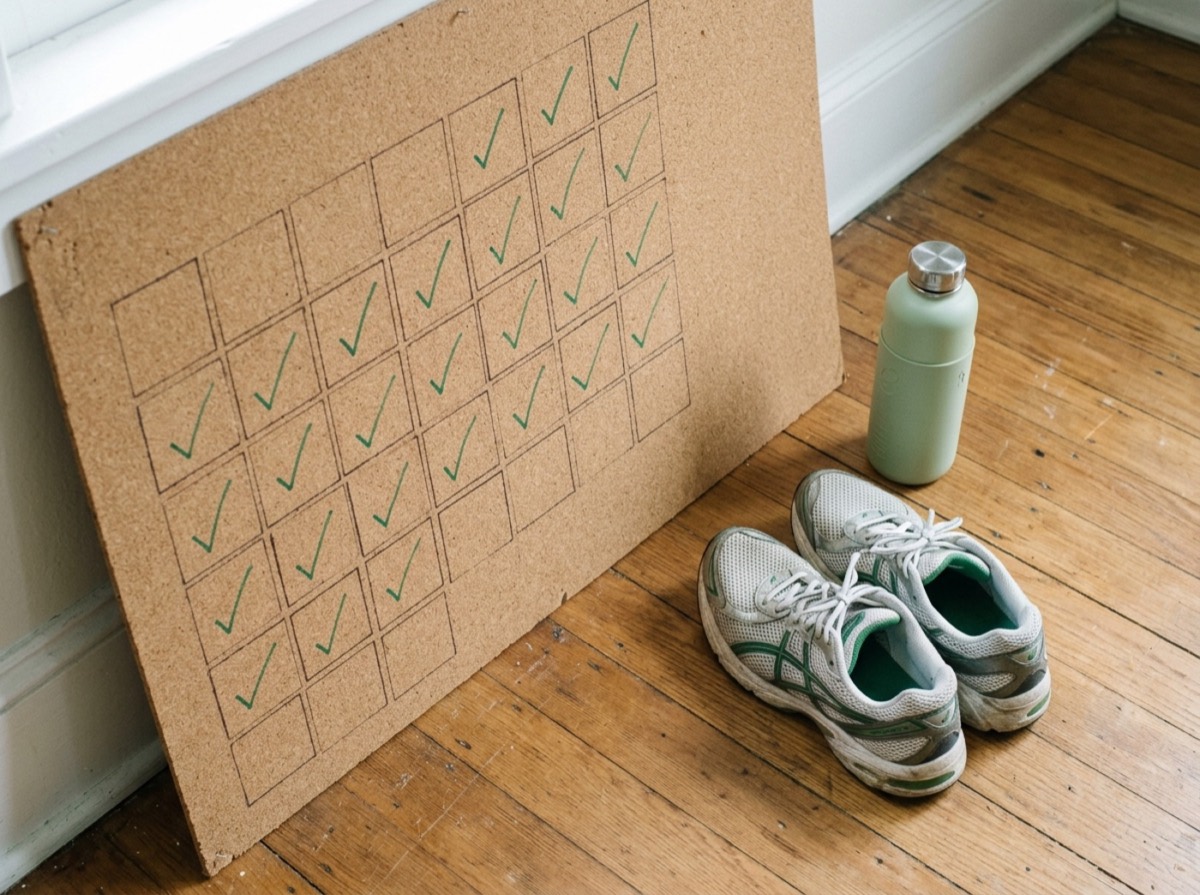
Many good habits pay off only in the long run, while the brain responds to what feels good now. Bridge that gap with an immediate reward. Pair a workout with a podcast you only allow yourself during exercise, or check off the day on a paper calendar and enjoy watching the chain grow.
Tracking works because it turns invisible progress into something you can see. Keep it simple: a mark on a calendar or a tick in a notebook is enough. Pay attention to how the habit makes you feel afterward, too. Noticing that a walk clears your head is a reward in itself.
What to do when you miss a day
Everyone misses days. The habit is rarely lost on the first miss; it is lost when one miss becomes a week. A useful rule is never to miss twice in a row. If you skip Monday, Tuesday becomes the most important day of the plan.
Have a minimum version ready for bad days. If you normally exercise for thirty minutes, the fallback might be five minutes of stretching. Doing the small version keeps the identity and the routine alive, which matters more than any single session.
How to break a bad habit
Breaking a habit follows the same logic in reverse. Identify the cue that triggers it, whether a time, a place, a feeling or a person. Then either remove the cue or replace the routine with a different behavior that delivers a similar reward.
If you reach for your phone whenever you feel bored, keep a book or a notepad within reach instead. Trying to simply stop, without a replacement, usually leaves a gap that the old habit fills again.
Frequently asked questions
Is it true that it takes 21 days to form a habit?
+
No. The 21-day figure is a myth that spread from self-help books. Research suggests the average is closer to two months, with a wide range depending on the person and how difficult the habit is.
How many habits should I build at once?
+
One or two at a time works best. Each new habit needs attention during its early weeks, and spreading that attention across many changes makes it more likely that all of them fade. Add the next habit once the first feels automatic.
What is habit stacking?
+
Habit stacking is linking a new habit to one you already do every day, using the formula "after I do X, I will do Y." The existing habit acts as a reliable reminder, so you do not have to rely on memory or motivation.
Why do I keep failing to stick to new habits?
+
The usual causes are starting too big, having no clear cue and relying on motivation. Shrink the habit, tie it to a specific time and place, and remove friction from your environment. Treat a missed day as normal rather than as proof of failure.
Does missing one day ruin a habit?
+
No. Research on habit formation found that a single missed day had little effect on long-term progress. What matters is getting back on track quickly, ideally the very next day.
What is the best time of day to build a new habit?
+
The best time is whenever you have a stable, daily anchor to attach it to. Many people find mornings easier because fewer unexpected events have happened yet, but a consistent evening routine works just as well.
Habits that stick are built on purpose. Choose one behavior, shrink it until it feels almost too easy, anchor it to something you already do and make it visible and rewarding. Expect the process to take weeks or months, forgive the missed days and keep returning to the routine. Over time the effort fades and the habit simply becomes part of how you live.
How we research: Guides are written from established sources and checked for accuracy. They are general information, not professional advice.
Written by
Bitezine Editorial Team
Rankings, reviews & guides
Our editors research every piece from makers’ documentation, independent tests and owner reports, and update it when products change.