Food & Drink
How to make stock: chicken, beef, fish and vegetable stock at home
How to make stock at home from bones or vegetables: chicken, brown beef, fish and vegetable stock, simmering times, skimming, straining, cooling and freezing safely.
 Bitezine Editorial TeamRankings, reviews & guides 5 min read
 AI generated
Learning how to make stock turns bones and vegetable trimmings into the base for better soups, sauces, risottos and gravies. Homemade stock has a cleaner, deeper flavour than most cubes and powders, and you control the salt.
This guide explains the difference between stock and broth, gives methods for chicken, beef, fish and vegetable stock, and covers straining, cooling and storing it safely, which matters because a large pot of warm liquid is an ideal place for bacteria to grow.
What is the difference between stock and broth?
Stock is a savoury liquid made by simmering bones, meat, seafood or vegetables in water. It is the foundation of many soups, stews and sauces. Stock made from bones is rich in gelatin, which comes from the collagen in cartilage and connective tissue and gives the liquid body. A good chicken or beef stock sets to a wobbly jelly in the fridge.
The line between stock and broth is blurry. Broth is often made with more meat, simmered for less time and seasoned so it can be eaten on its own, while stock is usually left unseasoned for cooking. Bone broth is essentially a long-simmered stock. It is a comforting, useful ingredient, though many of the health claims made for it are not backed by scientific evidence.
What you need to make stock
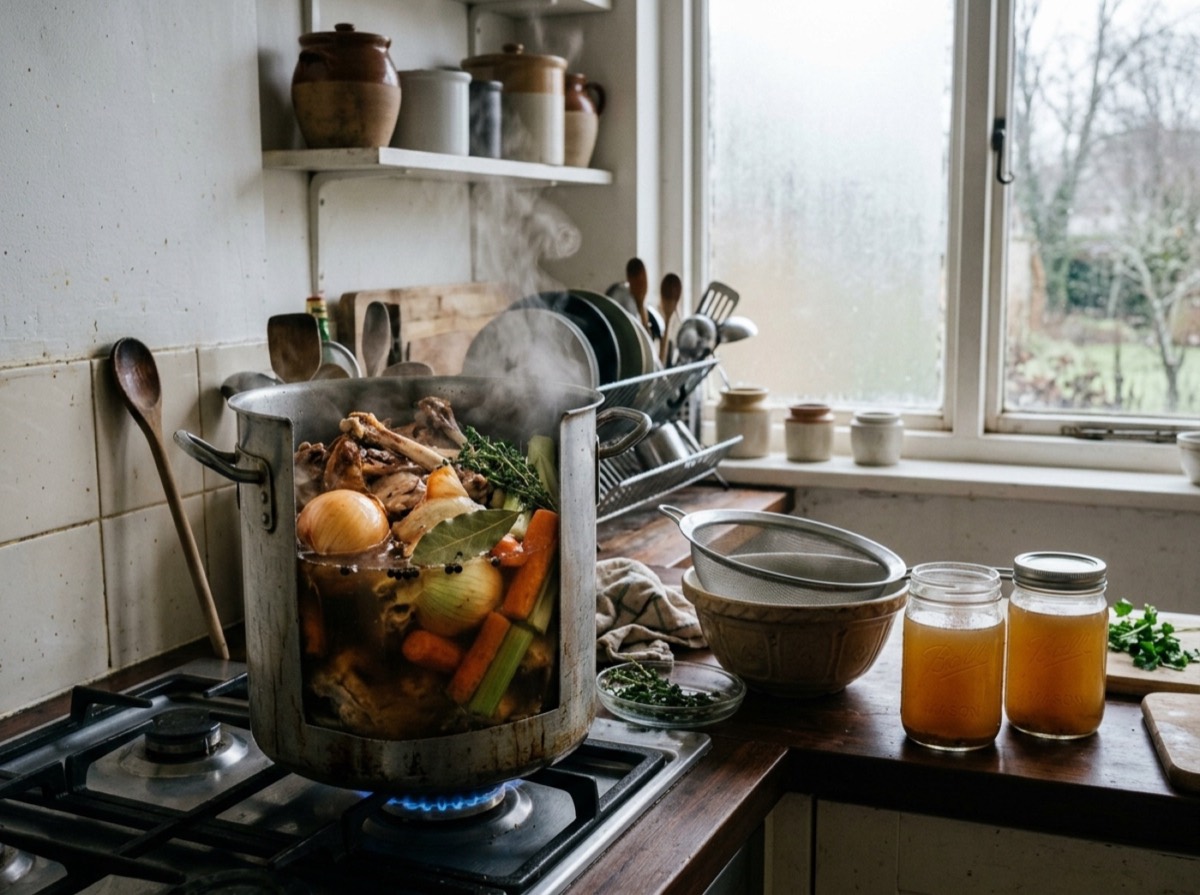
The basic formula is bones or vegetables, aromatics and cold water. The classic aromatic base is mirepoix: onion, carrot and celery, roughly two parts onion to one each of carrot and celery. A bouquet garni of parsley stalks, thyme and a bay leaf, plus a few whole peppercorns, completes it.
Leave out salt at this stage. Stock is often reduced, which concentrates any salt, so season the final dish instead. Avoid strong or starchy vegetables such as cabbage, broccoli and potatoes, which can make stock bitter or cloudy.
Clarity depends mostly on heat: keep stock at a bare simmer, never a rolling boil.
How to make chicken stock
Chicken stock is the most versatile and the easiest place to start. A roast chicken carcass works well, and raw wings, backs or feet add extra gelatin.
- Put about 1 to 1.5 kg of chicken bones in a large pot and cover with cold water by a few centimetres.
- Bring slowly to a gentle simmer, skimming off the grey foam that rises.
- Add a quartered onion, a carrot, a celery stick, a bay leaf, thyme, parsley stalks and peppercorns.
- Simmer very gently, uncovered or partly covered, for about 3 to 4 hours, topping up with water if the bones become exposed.
- Strain through a fine sieve, pressing lightly, and discard the solids.
How to make brown beef stock
A white stock, called fond blanc in French kitchens, uses raw bones. A brown stock, or fond brun, uses roasted bones and vegetables for a darker colour and deeper, roasted flavour that suits gravies, stews and French onion soup.
Roast beef or veal bones in a hot oven at about 220°C until well browned, around 45 minutes, adding the chopped vegetables for the last 20 minutes. A spoon of tomato paste brushed on towards the end adds colour. Transfer everything to a pot, pour a little water into the roasting tin to lift the browned bits and add that too. Cover with cold water and simmer very gently for 6 to 8 hours, skimming often, then strain.
How to make fish stock and vegetable stock
Fish stock is quick. Use the bones and heads of white fish, gills removed and rinsed, with onion, fennel or celery, parsley stalks and a splash of dry white wine. Simmer for only 20 to 30 minutes; longer cooking makes it bitter. Oily fish such as salmon or mackerel give a strong, greasy result and are best avoided.
Vegetable stock needs about 45 minutes to an hour. Use onions, carrots, celery, leeks, mushrooms, tomatoes, garlic and herbs. Browning the vegetables in a little oil first gives more depth. Clean vegetable trimmings kept in a bag in the freezer are an easy way to collect ingredients.
Why is my stock cloudy? Tips for a clear stock
Clarity depends mostly on heat. Boiling stock hard churns fat and proteins into the liquid and makes it cloudy and greasy. Cloudy stock is perfectly safe and still tastes good; it simply looks less refined.
- Start with cold water and heat it slowly.
- Keep it at a bare simmer, with only an occasional bubble breaking the surface.
- Skim the foam and fat regularly, especially in the first hour.
- Do not stir the pot.
- Strain through a sieve lined with muslin or a clean cloth.
- Chill the stock and lift off the solid layer of fat.
How to cool and store homemade stock safely
A big pot of stock holds heat for a long time, and warm, protein-rich liquid is a perfect environment for bacteria. Cool it quickly: strain it, divide it into smaller shallow containers, and stand them in a sink of cold water or ice, stirring now and then. UK food safety guidance is to get cooked food into the fridge within one to two hours and keep the fridge between 0 and 5°C. Do not leave stock to cool on the hob overnight.
Use refrigerated stock within about two days, following the general UK guidance of eating leftovers within 48 hours, or freeze it. Stock freezes well for several months. Freeze it in portions, or reduce it first and freeze it in ice cube trays for concentrated flavour. When reheating, bring it to a full boil before using it.
Frequently asked questions
How long should you simmer stock?
+
Roughly 3 to 4 hours for chicken stock, 6 to 8 hours for beef stock, 45 to 60 minutes for vegetable stock and only 20 to 30 minutes for fish stock. Keep the heat at a bare simmer throughout.
Should you add salt to homemade stock?
+
It is best not to. Stock is often reduced for sauces, which concentrates salt, so season the finished dish instead.
Can I make stock from a leftover chicken carcass?
+
Yes, and it is one of the best uses for it. Cover the carcass with cold water, add onion, carrot, celery and herbs, and simmer gently for a few hours before straining.
Why did my stock not turn to jelly?
+
It was either made with bones low in collagen, simmered too briefly or diluted with too much water. Adding chicken wings or feet and reducing the finished stock both help.
How long does homemade stock last in the fridge?
+
Treat it like other leftovers and use it within about two days. Freeze anything you will not use in that time, and boil it before using.
Can you make stock in a pressure cooker?
+
Yes. A pressure cooker extracts flavour and gelatin from bones much faster than a pot on the hob, typically in a fraction of the time. Let the pressure release naturally for a clearer result.
Once you know how to make stock, it becomes a habit: save bones and trimmings, simmer them gently on a quiet afternoon, cool the stock quickly and freeze it in portions. A freezer full of homemade chicken, beef and vegetable stock makes everyday soups and sauces taste noticeably better.
How we research: Guides are written from established sources and checked for accuracy. They are general information, not professional advice.
Written by
Bitezine Editorial Team
Rankings, reviews & guides
Our editors research every piece from makers’ documentation, independent tests and owner reports, and update it when products change.