Food & Drink
How to cook a steak in a pan: doneness, timing and resting
How to cook a steak in a pan: choosing the cut, seasoning, getting a hot sear, internal temperatures for rare to well done, resting and slicing against the grain.
 Bitezine Editorial TeamRankings, reviews & guides 6 min read
 AI generated
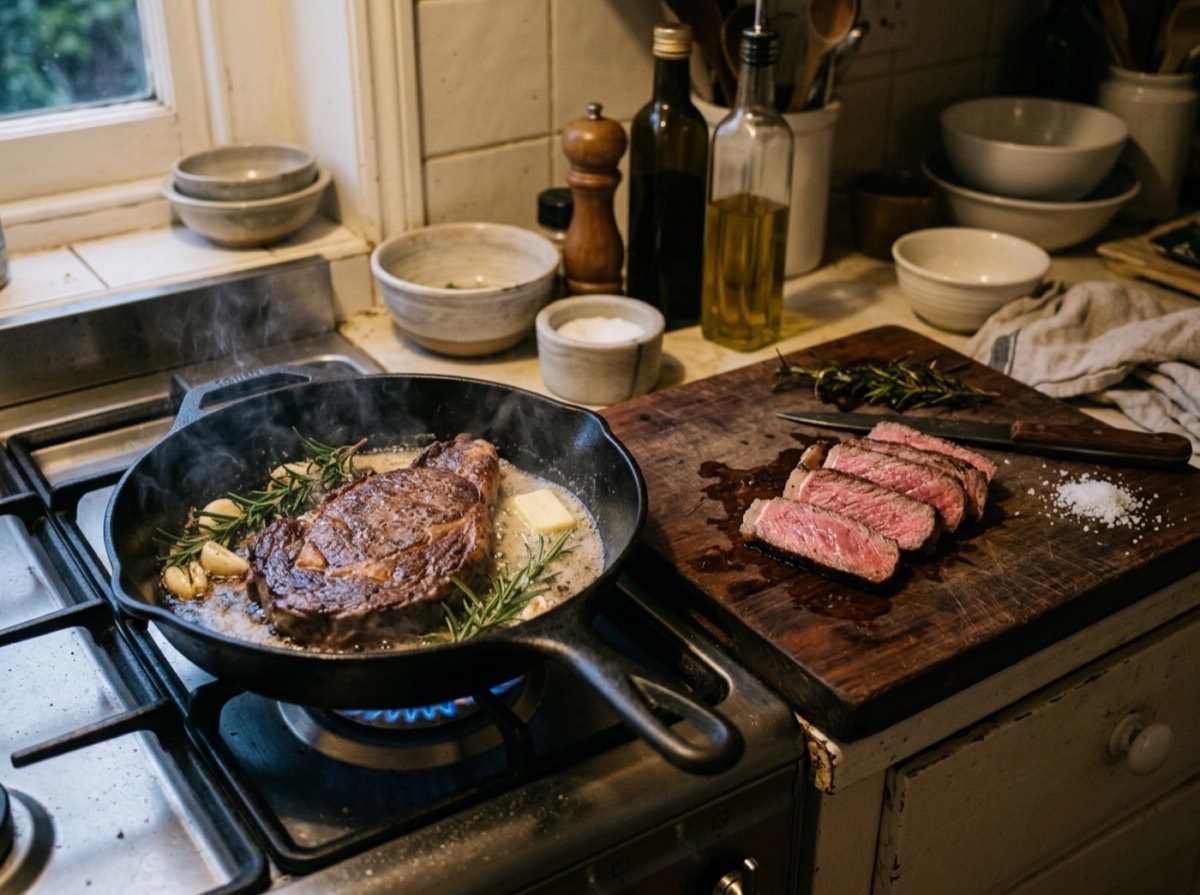
Knowing how to cook a steak well comes down to a dry surface, a very hot pan, an accurate idea of doneness and a few minutes of rest. You do not need a grill or special equipment; a heavy frying pan gives an excellent crust.
This guide covers choosing a cut, seasoning, pan-searing step by step, internal temperatures from rare to well done, the reverse-sear method for thick steaks, resting and slicing, plus what food safety guidance says about eating steak pink.
Which cut of steak should you choose?
Tender cuts from the loin and rib are best for quick pan-cooking. Ribeye is richly marbled with fat and very forgiving. Sirloin, also called strip or striploin, has a firmer bite and a strip of fat along one edge. Fillet, or tenderloin, is the most tender and very lean, so it is easy to overcook. Flavourful, cheaper cuts such as rump, flank, skirt and hanger work well too, as long as they are cooked no further than medium and sliced thinly against the grain.
Aim for steaks about 2.5 to 4 cm thick. Thin steaks overcook before they brown; thicker ones give you time to build a crust while the centre stays pink.
How to prepare and season steak
Take the steak out of the fridge 20 to 30 minutes before cooking so the chill comes off the surface, and pat it very dry with kitchen paper. Moisture is the enemy of a good crust, because the pan has to boil it off before browning can start.
Salt generously. You can salt just before cooking, or salt 40 minutes or more ahead, even overnight uncovered in the fridge, which seasons the meat more deeply and dries the surface. Many cooks avoid salting only a few minutes ahead, because the salt draws moisture to the surface, and a wet surface browns less readily. Add black pepper just before or after cooking, as it can burn in a very hot pan.
The crust is about flavour, not sealing in juices.
How to cook steak in a pan, step by step
Cast iron or heavy stainless steel holds heat best. Non-stick pans are not designed for very high heat.
- Heat the dry pan over high heat for several minutes until very hot.
- Add a thin film of oil with a high smoke point, such as sunflower or rapeseed oil.
- Lay the steak away from you and leave it alone for 2 to 3 minutes until a deep brown crust forms.
- Turn it and cook the other side. Turning every minute is also fine and cooks the steak evenly; the key is steady high heat.
- Hold the steak on its side with tongs to render and brown the fat edge.
- In the last minute or two, add a knob of butter, a crushed garlic clove and thyme or rosemary, tilt the pan and spoon the foaming butter over the steak.
- Check the internal temperature, then move the steak to a warm plate to rest.
Steak doneness temperatures: rare to well done
A digital thermometer inserted sideways into the centre is the most accurate test. Meat keeps cooking after it leaves the pan, typically rising a further 3 to 5°C, so take it off a few degrees below your target. The ranges below are the usual kitchen guide for the final temperature.
- Blue: about 46 to 49°C, very red and barely warm
- Rare: about 52 to 55°C, red centre, soft
- Medium rare: about 55 to 60°C, warm red centre, slightly firmer
- Medium: about 60 to 65°C, pink and firm
- Medium well: about 65 to 69°C, a trace of pink
- Well done: 71°C and above, brown throughout
How long to cook steak without a thermometer
Times vary with thickness, pan and heat, but for a 2.5 cm steak in a very hot pan, a rough guide is about 2 minutes per side for rare, 3 minutes per side for medium rare, 4 minutes per side for medium and 5 to 6 minutes per side for well done. Thicker steaks need longer, ideally finished in the oven.
The touch test is a useful backup: rare meat feels soft and yielding, medium feels springy and well done feels firm. It takes practice, so a thermometer is still the better investment.
The reverse sear method for thick steaks
For steaks over about 4 cm, the reverse sear gives even colour from edge to edge. Put the seasoned steak on a rack over a tray in a low oven, around 110 to 120°C, until the centre is about 10°C below your target. Depending on thickness, that can take 30 to 60 minutes. Then sear it in a very hot pan for about a minute per side to build the crust. Because the steak has already rested in the oven, it needs little or no resting afterwards.
Why rest steak, and how to slice it
Rest a pan-seared steak for about 5 minutes, or around half its cooking time, on a warm plate or board. This lets the temperature even out and the juices settle, so less runs out when you cut. The popular idea that searing seals in juices is a myth; the crust is about flavour, created by the browning reactions between proteins and sugars at high heat.
Look for the lines of muscle fibre and slice across them, not along them. Cutting against the grain shortens the fibres and makes every bite more tender, which matters most for flank, skirt and hanger.
Is rare steak safe to eat?
For whole cuts of beef and lamb, bacteria are normally found on the outside surface, not inside the meat. UK food safety guidance says such whole cuts can be served pink in the middle, as long as the outside is properly seared. US guidance from the USDA is more cautious, recommending a minimum of 63°C (145°F) followed by a three-minute rest.
Minced beef is different, because mincing spreads surface bacteria all the way through. Burgers and other minced meat should be cooked until there is no pink in the centre; US guidance is 71°C (160°F). People who are pregnant, very young, elderly or have weakened immune systems are generally advised to choose steak cooked further. Always keep raw meat and its juices away from ready-to-eat food, and wash boards and hands after handling it.
Frequently asked questions
What temperature is medium rare steak?
+
About 55 to 60°C in the centre after resting. Take the steak out of the pan a few degrees earlier, since it keeps cooking while it rests.
How long should I rest a steak?
+
About 5 minutes for a typical pan-seared steak, or roughly half the cooking time. Reverse-seared steaks need little or no rest.
Should I cook steak with butter or oil?
+
Start with a neutral oil that tolerates high heat, then add butter near the end for flavour and basting. Butter alone burns at the temperatures needed for a good sear.
How often should you flip a steak?
+
Either way works. Flipping once gives a good crust with less fuss, while flipping every minute cooks the steak more evenly and slightly faster. Steady high heat matters more than the number of turns.
Why is my steak tough?
+
It was overcooked, cut along the grain or a chewy cut cooked too far. Use a thermometer, slice against the grain and keep cuts like flank and skirt to medium rare or medium.
Can you cook a steak from frozen?
+
It can be done by searing first and finishing in a low oven, but it takes longer and is harder to control. Defrosting in the fridge overnight gives more predictable results.
The best way to learn how to cook a steak is to use a thermometer a few times until you know what each stage looks and feels like. Pick a good cut, dry and salt it, sear it hard in a heavy pan, rest it briefly and slice against the grain. Handle raw meat with care, and you will cook a steak that suits your taste every time.
How we research: Guides are written from established sources and checked for accuracy. They are general information, not professional advice.
Written by
Bitezine Editorial Team
Rankings, reviews & guides
Our editors research every piece from makers’ documentation, independent tests and owner reports, and update it when products change.