Tech
How to choose a power bank: capacity, charging speed and flight rules
How to choose a power bank that fits your phone, tablet or laptop: what mAh really means, fast charging standards, ports, wireless models and airline rules.
 Bitezine Editorial TeamRankings, reviews & guides 6 min read
 AI generated
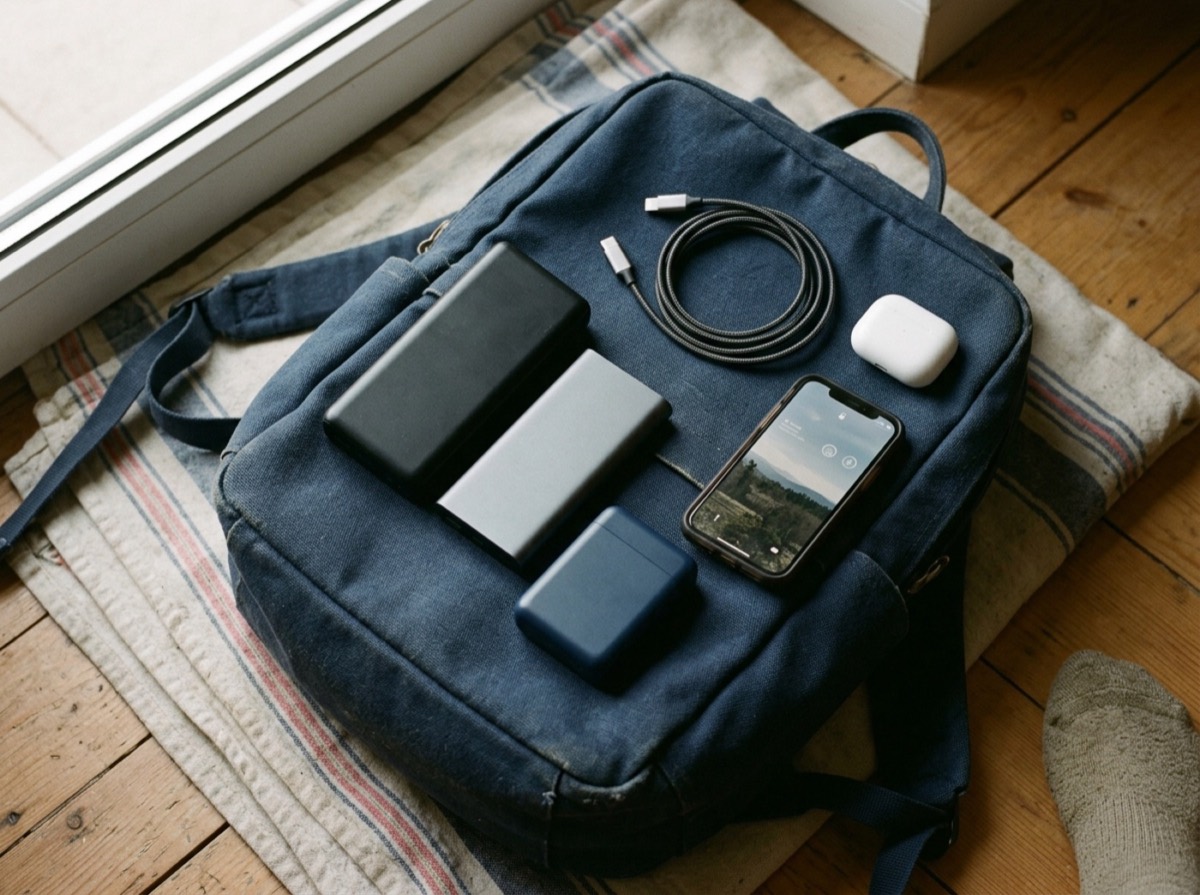
Learning how to choose a power bank comes down to three questions: how much energy you need, how fast you want it delivered, and where you will carry it. Get those right and a portable charger becomes one of the most useful things in your bag, whether you commute, travel or spend long days away from a socket.
This guide explains what capacity figures really mean, how many charges to expect, which charging standards matter for phones and laptops, and the safety and airline rules every power bank owner should know.
What size power bank do I need?
Capacity is usually listed in milliamp-hours (mAh). As a rough guide, match the size to your devices and how long you are away from power.
- 5,000 mAh: slim and pocketable, good for a top-up of about one phone charge on a busy day.
- 10,000 mAh: the most popular size, typically enough for around two full charges of a typical smartphone while still fitting a jacket pocket.
- 20,000 mAh: suits weekends away, tablets, or charging two phones; heavier, often around the weight of a full-size phone or more.
- 25,000 mAh and above: aimed at laptops, long trips and groups, but check airline limits before flying.
Why real capacity is lower than the number on the box
The rated capacity refers to the battery cells inside, which run at around 3.6 to 3.7 volts. USB charging happens at 5 volts or more, so the power bank has to convert the voltage, and some energy is lost as heat in the process and in your phone's own charging circuit. In practice, you can expect roughly 60 to 70 percent of the stated mAh to reach your device.
That means a 10,000 mAh power bank delivers something like 6,000 to 7,000 mAh to a phone. Divide that by your phone's battery capacity to estimate the number of full charges. Wireless charging wastes more energy than a cable, so expect fewer charges if you use it.
Capacity tells you how much energy is stored; output wattage tells you how fast it comes out.
mAh vs Wh: the figure that matters for laptops and flights
Watt-hours (Wh) measure energy in a way that accounts for voltage, which makes them a fairer comparison between devices. To convert, multiply the mAh by the cell voltage and divide by 1,000. A 10,000 mAh bank at 3.7 volts holds about 37 Wh; a 20,000 mAh bank holds about 74 Wh.
Laptop batteries are usually listed in Wh, so this figure tells you how much of a laptop charge to expect. Airlines also set their limits in Wh, and reputable power banks print the Wh rating on the casing.
Charging speed: USB-C Power Delivery and output wattage
Capacity tells you how much energy is stored; output wattage tells you how fast it comes out. For modern phones, look for USB-C with USB Power Delivery (USB PD), the widely used fast charging standard. Some phones charge fastest with the PPS extension to USB PD, so check what your phone supports.
For a phone, 20 to 30 watts of output is plenty. Tablets and small laptops need around 45 watts or more, and larger laptops may need 65 to 100 watts or higher from a single USB-C port. When a power bank has several ports, the maximum output is often shared, so charging two devices at once can slow both.
Recharging the power bank itself matters too. A large bank with slow input can take a whole night to refill, while one that accepts high-wattage USB-C input can be full in a few hours with a suitable wall charger.
Ports, wireless charging and other features
Think about the cables you carry and the features you will use.
- Ports: at least one USB-C port for input and output; a USB-A port helps with older cables and accessories.
- Built-in cable: convenient, as long as the connector matches your devices.
- Wireless and magnetic charging: snaps onto compatible phones for cable-free top-ups, at the cost of speed and efficiency.
- Pass-through charging: lets the power bank charge your device while it is itself plugged in, handy on a hotel bedside table.
- Display: a percentage readout is more precise than four small LEDs.
- Low-current mode: useful for earbuds, fitness bands and other small gadgets that some power banks do not detect.
Can I take a power bank on a plane?
Power banks contain lithium-ion batteries, so aviation rules treat them carefully. Under the rules commonly applied by airlines and aviation authorities, power banks must travel in carry-on baggage and are never allowed in checked luggage. Banks up to 100 Wh are generally permitted, those between 100 and 160 Wh need airline approval, and anything larger is not allowed on passenger aircraft.
Rules have been getting stricter. A growing number of airlines ban using or recharging power banks during the flight, limit how many each passenger may carry, or ask you to keep them on your person rather than in an overhead bin. Always check your airline's current policy before travelling, and make sure the Wh rating is clearly printed on the device, because security staff may refuse unlabelled batteries.
Power bank safety tips
Buy from reputable sellers and look for recognised safety certifications and protections against overcharging, overheating and short circuits. Very cheap, unbranded power banks sometimes overstate their capacity and skip safety features.
Avoid leaving a power bank in a hot car or direct sun, and do not charge it on a bed or under a pillow, where heat cannot escape. Stop using it immediately if it swells, smells, gets unusually hot or is damaged, and take it to a battery recycling point rather than the household bin. If you store a power bank for months, keep it at around half charge and top it up occasionally.
Frequently asked questions
How many times can a 10,000 mAh power bank charge my phone?
+
Usually around two full charges for a typical smartphone. Conversion losses mean only about 60 to 70 percent of the rated capacity reaches the phone, so phones with larger batteries get fewer charges.
What power bank do I need to charge a laptop?
+
Look for a USB-C Power Delivery port with enough output for your laptop, often 45 to 100 watts, and a capacity of at least 20,000 mAh. Check that your laptop supports USB-C charging.
Can I bring a 20,000 mAh power bank on a plane?
+
Generally yes, because a 20,000 mAh bank is about 74 Wh, below the common 100 Wh limit. It must be in your carry-on bag, and some airlines restrict using it during the flight.
Is it bad to leave a power bank plugged in overnight?
+
A quality power bank stops charging when full, so it is generally fine. Charge it on a hard surface away from bedding and stop using any bank that gets very hot or swells.
Are wireless power banks worth it?
+
They are convenient for quick, cable-free top-ups, especially magnetic models. They charge more slowly and waste more energy than a cable, so a model with a USB-C port as well gives you both options.
How long does a power bank last?
+
Most power banks keep good performance for a few hundred full charge cycles, which is often several years of normal use. Capacity gradually declines, and heat speeds that up.
The right power bank is the one that matches your devices and your days. Choose a capacity based on how many charges you really need, check the output wattage and USB-C support, keep the Wh rating in mind for flights, and buy from a brand that takes safety seriously.
How we research: Guides are written from established sources and checked for accuracy. They are general information, not professional advice.
Written by
Bitezine Editorial Team
Rankings, reviews & guides
Our editors research every piece from makers’ documentation, independent tests and owner reports, and update it when products change.