Culture
History of the printing press: from Gutenberg to the modern page
The history of the printing press, from early Asian movable type to Gutenberg's workshop in Mainz and the way printed books reshaped Europe and the world.
 Bitezine Editorial TeamRankings, reviews & guides 6 min read
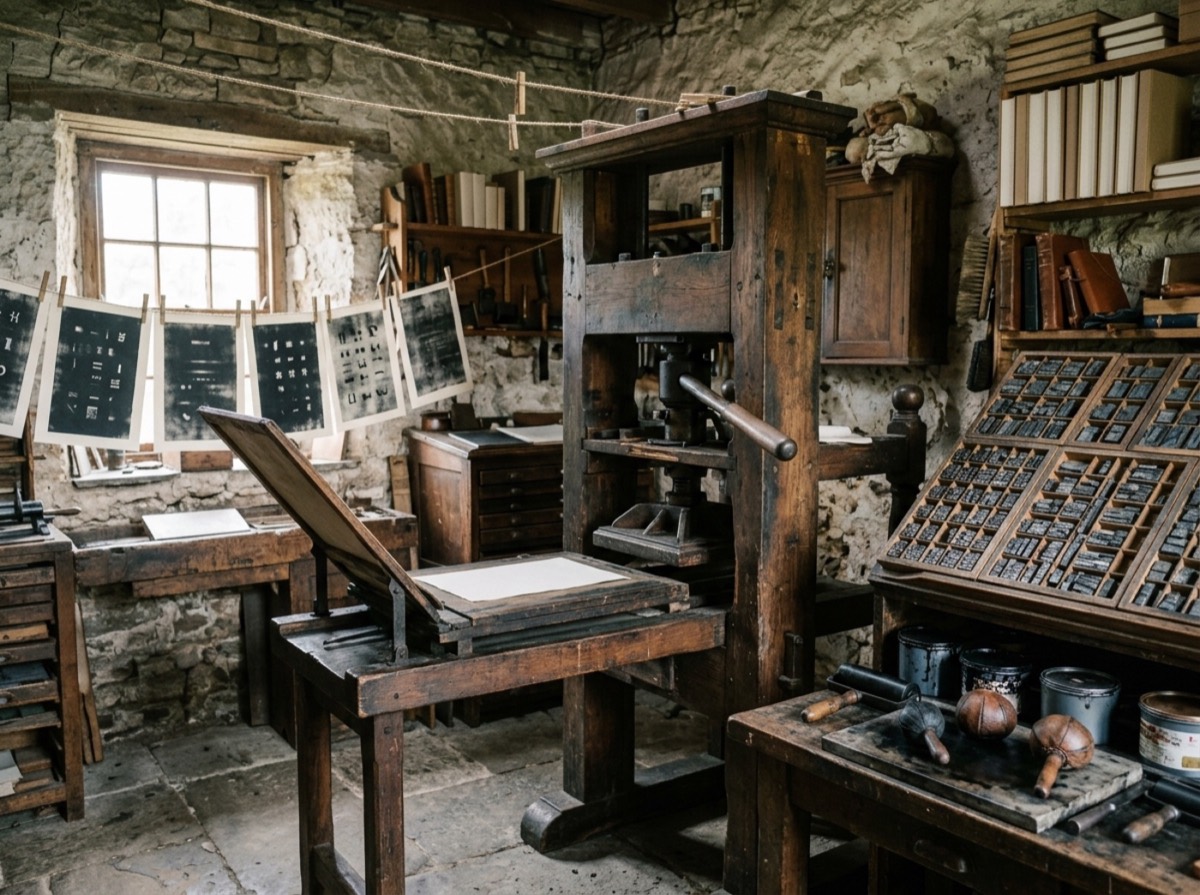 AI generated
The history of the printing press is one of the great turning points in human culture. When Johannes Gutenberg developed a practical system of movable metal type in Mainz in the mid-fifteenth century, he made it possible to produce books faster, cheaper and in far greater numbers than ever before.
This article explains what came before Gutenberg, how his press actually worked, why the Gutenberg Bible matters, how printing spread across Europe and what it changed in religion, science and everyday life.
Printing before Gutenberg
Printing did not begin in Europe. In China, woodblock printing was in use centuries earlier: an entire page was carved into a block of wood, inked and pressed onto paper. The Diamond Sutra, a printed Buddhist text dated to 868, is one of the oldest surviving dated printed books.
Movable type also has Asian roots. Around the 1040s, the Chinese artisan Bi Sheng created movable characters from baked clay. In Korea, metal movable type was used during the Goryeo period, and the Jikji, a Buddhist text printed in 1377, is widely recognised as the oldest surviving book printed with movable metal type.
In medieval Europe, books were copied by hand, first mainly in monasteries and later in professional workshops as universities grew. Hand-copied manuscripts were slow to make and expensive, which kept books in the hands of a few. Paper, which had spread to Europe from the Islamic world, was becoming cheaper, setting the stage for change.
Who invented the printing press?
Johannes Gutenberg, a goldsmith from Mainz in what is now Germany, is credited with inventing the European printing press with movable metal type. He worked on the system in Strasbourg and Mainz, and by around 1450 his workshop was printing.
Gutenberg's achievement was not a single invention but a combination of several: a method for casting large numbers of identical metal letters, a durable alloy for the type, an oil-based ink that stuck to metal, and a press adapted from those used for wine and paper-making. Together they formed a system that could be repeated at scale.
Gutenberg's achievement was not a single invention but a combination of several.
How did the Gutenberg printing press work?
The process moved through a series of steps that stayed broadly the same in print shops for centuries:
- Punches: a metalworker cut each letter in reverse into the end of a hard steel punch.
- Matrices: the punch was struck into softer metal, such as copper, to make a mould of the letter.
- Casting: a hand mould held the matrix while molten type metal, an alloy based on lead, was poured in, producing identical letters quickly.
- Composition: a compositor arranged the individual letters, line by line, into a frame to form a page.
- Inking: the type was inked with leather ink balls using a sticky, oil-based ink.
- Pressing: paper or vellum was laid on the type, and a screw press brought a flat plate down to transfer the ink evenly.
- Reuse: after printing, the letters were cleaned and redistributed for the next job.
The Gutenberg Bible
Gutenberg's most famous work is the Bible completed in Mainz around 1455. It is often called the 42-line Bible, because most pages carry 42 lines of text per column. Around 180 copies are thought to have been printed, some on paper and some on vellum.
The book was designed to look like a fine manuscript, with a Gothic typeface and space left for hand-painted initials and decoration. Fewer than 50 copies survive, many of them incomplete, and they are among the most valuable books in the world.
Gutenberg himself did not grow rich from it. A legal dispute with his financial backer, Johann Fust, cost him much of his workshop, and Fust continued printing with Gutenberg's former assistant Peter Schöffer.
How the printing press spread across Europe
Printing spread with remarkable speed. Craftsmen trained in Mainz carried the skills to other cities, and presses were running in Italy, France, the Low Countries, Spain and England within a few decades. By 1500, presses were operating in more than 200 European towns and cities, and millions of volumes had been printed.
Books printed in Europe before 1501 are known as incunabula, from a Latin word linked to the cradle, since they come from the infancy of printing. Venice became one of the leading printing centres, known for innovations such as italic type and smaller, portable books. In England, William Caxton set up a press in Westminster in the 1470s.
How did the printing press change the world?
The consequences reached into almost every part of life:
- Knowledge spread faster and further, because identical copies could circulate widely.
- Book prices fell, and reading gradually spread beyond clergy and the wealthy.
- Texts became more standardised, which helped fix spelling and grammar in many languages.
- Scholars could compare the same edition, supporting the growth of science.
- Writing in local languages gained ground alongside Latin.
- News, pamphlets and later newspapers created new forms of public debate.
The printing press and the Reformation
The Protestant Reformation shows the new power of print. After Martin Luther published his theses in 1517, printed copies and pamphlets spread his arguments across the German-speaking lands within weeks. His German translation of the Bible reached a wide readership and influenced the development of standard written German. Opponents used the press just as actively, turning print into a battlefield of ideas.
From hand press to modern printing
The basic hand press changed little for about 350 years. The nineteenth century brought iron presses, steam-powered cylinder presses and rotary printing, which made mass newspapers possible. Mechanical typesetting machines replaced hand composition, and offset lithography later became the standard for commercial printing. Today, digital printing and on-screen reading dominate, but the page layout, typefaces and many printing terms still trace back to the workshops of the fifteenth century.
To see the story in person, the Gutenberg Museum in Mainz displays early printed books and demonstrates how a replica hand press works.
Frequently asked questions
Who invented the printing press?
+
Johannes Gutenberg of Mainz developed the European printing press with movable metal type around 1440 to 1450. Movable type had existed earlier in China and Korea, but Gutenberg's complete system made mass production of books practical in Europe.
When was the printing press invented?
+
Gutenberg developed his press in the 1440s, and his workshop in Mainz was printing by around 1450. The Gutenberg Bible was completed around 1455.
What was the first book printed on the printing press?
+
The Gutenberg Bible is the first major book printed with movable metal type in Europe. Gutenberg's workshop printed smaller items, such as indulgences and grammar texts, before it. Outside Europe, printed books are much older.
How did the printing press work?
+
Individual metal letters were cast in moulds, arranged into pages, inked with an oil-based ink and pressed onto paper with a screw press. The letters could then be reused for new pages.
Why was the printing press so important?
+
It made books cheaper and more plentiful, spread ideas quickly, standardised texts and languages and helped drive the Reformation, the scientific revolution and rising literacy.
How many Gutenberg Bibles still exist?
+
Fewer than 50 copies survive, and many are incomplete. Around 180 are believed to have been printed originally, on both paper and vellum.
The history of the printing press is a story of combining existing ideas into something far more powerful. Gutenberg's workshop in Mainz turned books from rare objects into tools anyone could hope to own, and the effects are still visible every time you open a book or read a page on a screen.
How we research: Guides are written from established sources and checked for accuracy. They are general information, not professional advice.
Written by
Bitezine Editorial Team
Rankings, reviews & guides
Our editors research every piece from makers’ documentation, independent tests and owner reports, and update it when products change.