Food & Drink
Health benefits of nuts: what the research suggests and how to eat them
What are the health benefits of nuts? A balanced look at their nutrients, what research suggests about heart health, sensible portions and who should be careful.
 Bitezine Editorial TeamRankings, reviews & guides 6 min read
 AI generated
The health benefits of nuts have been studied for decades, and the overall picture is encouraging: eaten in sensible amounts, nuts fit well into a balanced diet and are linked in research with better heart health outcomes. They are also calorie-dense and a common allergen, so the details matter.
This guide summarises what nuts contain, what the evidence suggests and where it stays uncertain, how much makes a reasonable portion and how to include nuts in everyday meals. It is general information, not medical advice; anyone with a health condition or allergy should follow their doctor's or dietitian's guidance.
What counts as a nut?
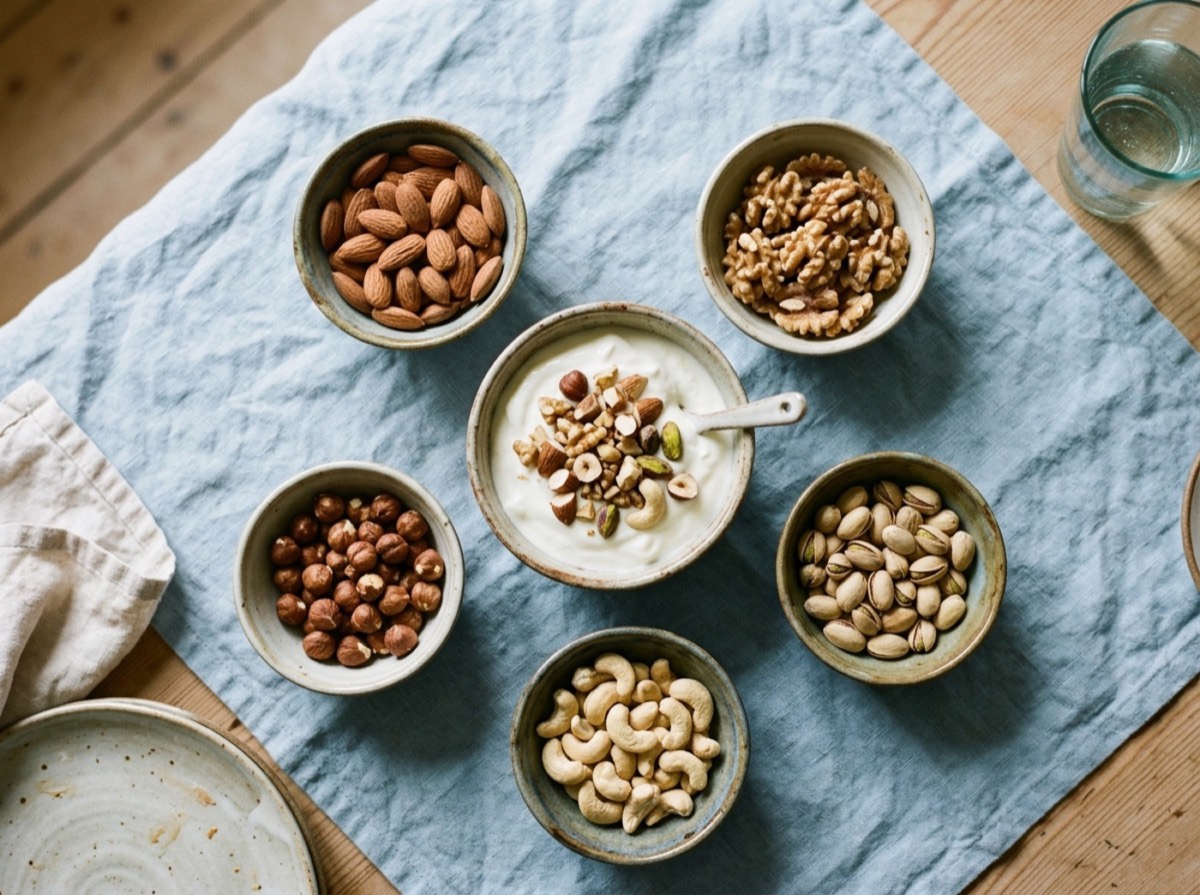
In the kitchen, 'nuts' covers a wide group: almonds, walnuts, hazelnuts, cashews, pistachios, pecans, macadamias, Brazil nuts and pine nuts, among others. Botanically, only a few, such as hazelnuts and chestnuts, are true nuts; many others are seeds or the stones of fruits.
Peanuts are legumes, related to beans and peas, but their nutrient profile is similar to tree nuts, so nutrition research often groups them together. For allergy purposes, however, peanuts and tree nuts are treated separately. Chestnuts are the odd one out: they are starchy and much lower in fat than other nuts.
What nutrients are in nuts?
Most nuts are low in water and carbohydrate and rich in fat, with useful amounts of protein and fibre. The fat is mainly unsaturated, which dietary guidelines generally favour over saturated fat.
- Unsaturated fats, including omega-3 ALA, which walnuts are especially known for
- Plant protein, roughly 4 to 7 g in a 30 g handful depending on the nut
- Dietary fibre, often 2 to 4 g per handful
- Vitamin E, particularly in almonds and hazelnuts
- Minerals such as magnesium, copper, phosphorus, potassium and zinc
- Selenium, which Brazil nuts contain in unusually high amounts
- Plant compounds such as polyphenols and phytosterols
Nuts work best as a swap for less nourishing snacks, not as an addition on top of them.
Nuts and heart health: what studies suggest
Heart health is the most researched area. Large observational studies have repeatedly found that people who eat nuts regularly tend to have lower rates of heart disease than people who rarely eat them. Reviews pooling many of these studies have reported similar associations for overall mortality.
Observational studies cannot prove cause and effect, because nut eaters may differ in other habits. Controlled trials add some support: diets that include nuts have been shown to modestly improve blood cholesterol levels in many studies, especially when nuts replace less healthy snacks. In the United States, the FDA has allowed a qualified health claim for nuts and heart disease since 2003, with wording that makes clear the evidence suggests but does not prove a benefit.
The sensible reading is that nuts are a good choice within an overall healthy eating pattern, not a treatment. They do not replace medication, medical advice or other lifestyle measures.
Do nuts make you gain weight?
Nuts are energy-dense, with roughly 170 to 200 kcal in a 30 g handful. Even so, studies generally have not found that moderate nut eating leads to weight gain. Possible reasons include their protein and fibre, which help people feel full, and the fact that some of the fat in whole nuts is not fully absorbed.
Portion size still matters. Eating nuts straight from a large bag, or choosing versions coated in sugar, chocolate or lots of salt, can add up quickly. Measuring a portion into a small bowl is a simple habit that helps.
How many nuts should you eat a day?
Many dietary guidelines use a portion of about 30 g, which is roughly a small handful. That is around 20 to 25 almonds, 12 to 14 walnut halves or around 45 to 50 shelled pistachios. Research on heart health has often looked at intakes of around one portion a day or several portions a week.
Brazil nuts are an exception. Because they are so rich in selenium, and too much selenium over time can be harmful, it is sensible to eat only a few at a time rather than a full handful every day. Ground nuts and nut butters count too: about one to two tablespoons of nut butter is a comparable portion.
Which nuts are the healthiest?
There is no single healthiest nut. Each has strengths: walnuts for omega-3 ALA, almonds for vitamin E and fibre, pistachios for protein per calorie, Brazil nuts for selenium, cashews for zinc and iron. A mix across the week gives the broadest range of nutrients.
How nuts are prepared matters more than which type you choose. Plain raw or dry-roasted nuts are the best everyday option. Salted, honey-roasted or chocolate-coated nuts can be a treat, but they add sodium or sugar.
Who should be careful with nuts?
Nut allergies are among the most common food allergies and can cause severe reactions, including anaphylaxis. Anyone with a known or suspected allergy should follow medical advice and check labels; in the EU, peanuts and several tree nuts must be highlighted as allergens on packaged food.
Whole nuts are a choking hazard for young children, so health services generally advise against giving them to children under five. Finely ground nuts or smooth nut butters are the usual alternative, with advice from a health professional if there is any allergy risk.
People on specific diets or medications, or with digestive conditions, should ask their doctor or dietitian how nuts fit their plan.
Easy ways to eat more nuts
Small swaps work best, so nuts replace something rather than being added on top.
- Sprinkle chopped nuts on porridge, yoghurt or salads
- Swap a biscuit or crisps for a measured handful of plain nuts
- Stir nut butter into sauces, dressings or overnight oats
- Use ground almonds or hazelnuts in baking
- Toast nuts briefly in a dry pan to bring out flavour without added fat
Frequently asked questions
Are nuts good for you?
+
For most people, yes, when eaten in moderate portions. They provide unsaturated fats, protein, fibre, vitamins and minerals, and research links regular nut eating with better heart health, although observational studies cannot prove cause and effect.
How many nuts should I eat a day?
+
A common guideline portion is about 30 g, roughly a small handful. Brazil nuts are an exception because of their high selenium content, so keep to just a few at a time.
Are roasted nuts less healthy than raw nuts?
+
Dry-roasted nuts are nutritionally very similar to raw ones, with small losses of some heat-sensitive nutrients. The bigger difference is added salt, oil or sugar, so plain versions are the better everyday choice.
Will eating nuts make me gain weight?
+
Studies generally suggest moderate nut intake does not lead to weight gain, possibly because nuts are filling. They are high in calories, though, so measuring portions helps.
Is a peanut a nut?
+
Botanically, a peanut is a legume, not a nut. Nutritionally it is similar to tree nuts, but peanut and tree nut allergies are separate and are labelled separately.
Can children eat nuts?
+
Whole nuts are a choking risk, so they are generally not recommended for children under five. Ground nuts or smooth nut butters are common alternatives; ask a health professional about allergy risk.
The health benefits of nuts are best understood as part of a bigger picture: a handful of plain nuts, eaten regularly in place of less nourishing snacks, fits well into a balanced diet and is associated in research with better heart health. Keep portions sensible, vary the types you eat, take allergies and choking risks seriously and ask a health professional if you have specific medical needs.
How we research: Guides are written from established sources and checked for accuracy. They are general information, not professional advice.
Written by
Bitezine Editorial Team
Rankings, reviews & guides
Our editors research every piece from makers’ documentation, independent tests and owner reports, and update it when products change.