Culture
Bauhaus design explained: history, principles and lasting influence
What Bauhaus design is, where it came from, its key principles and figures, famous designs, and how the German school still shapes homes and objects today.
 Bitezine Editorial TeamRankings, reviews & guides 6 min read
 AI generated
Bauhaus design is one of the most influential ideas of the twentieth century: the belief that art, craft and industry should work together to create well-made, functional objects and buildings for everyday life. The name comes from the Bauhaus, a German art and design school that existed for just fourteen years, yet its thinking still shapes the chairs, lamps, houses and typefaces around us.
This explainer covers the history of the Bauhaus, its key principles, the people behind it, the most famous designs and how to recognise the Bauhaus style today.
What is Bauhaus? A short history
The architect Walter Gropius founded the Staatliches Bauhaus in Weimar in 1919, merging an art academy with a school of arts and crafts. The name plays on the German word for building, "Bau", and on the medieval Bauhütte, the lodge of masons who built cathedrals together. Gropius's founding manifesto called for artists and craftspeople to work side by side, with building as the shared goal.
Political pressure in Weimar pushed the school to move to Dessau in 1925, where Gropius designed a new school building that opened in 1926 and became an icon of modern architecture. Gropius stepped down in 1928. The architect Hannes Meyer led the school until 1930, followed by Ludwig Mies van der Rohe, who moved it to a former factory in Berlin in 1932 after the Nazi-influenced local government in Dessau shut it there. Under pressure from the Nazi regime, including a police raid, the Bauhaus closed in 1933.
Key principles of Bauhaus design
The Bauhaus was never one fixed style, and its ideas changed under each director. Early Weimar years were influenced by Expressionism and handcraft. By the mid-1920s the school had turned towards industry, standardisation and designs suitable for mass production. A handful of principles run through its best-known work.
- Unity of art and craft: no hierarchy between fine art and applied design.
- Function first: an object's form should come from its purpose, often summed up as "form follows function", a phrase the Bauhaus inherited rather than coined.
- Honesty of materials: steel, glass, concrete and wood shown as they are, without disguise.
- Simplicity: clean lines, basic geometric shapes and little or no ornament.
- Design for industry: prototypes meant for affordable mass production.
- Learning by making: students trained in workshops as well as in theory.
The Bauhaus existed for only fourteen years, yet its ideas still shape the chairs, lamps and houses around us.
Who were the key Bauhaus figures?
The school gathered an extraordinary group of teachers, known as masters, alongside talented students who later became teachers themselves.
- Walter Gropius: founder, first director and architect of the Dessau building.
- Johannes Itten: developed the famous preliminary course, the Vorkurs, exploring colour, form and materials.
- László Moholy-Nagy: took over the preliminary course and pushed photography, typography and new media.
- Josef Albers: studied and then taught at the Bauhaus, known for his work on colour.
- Wassily Kandinsky and Paul Klee: painters who taught form and colour theory.
- Marcel Breuer: student turned head of the furniture workshop, pioneer of tubular steel furniture.
- Marianne Brandt: metal workshop designer known for lamps and tea services.
- Gunta Stölzl: led the weaving workshop, one of the school's most commercially successful.
- Ludwig Mies van der Rohe: final director and one of the century's leading modernist architects.
Famous Bauhaus designs and buildings
Many Bauhaus designs still look contemporary. Marcel Breuer's tubular steel club chair from the mid-1920s, later sold as the Wassily chair, showed how lightweight industrial materials could make furniture. The Bauhaus Dessau building, with its glass curtain wall and separate wings for workshops, teaching and studios, turned the school's ideas into architecture.
Other well-known work includes the Masters' Houses in Dessau, the geometric table lamps from the metal workshop, woven textiles, and experiments in sans-serif typography and lowercase-only lettering. Interestingly, one of the school's most profitable products was wallpaper.
Several Bauhaus sites in Weimar, Dessau and Bernau are UNESCO World Heritage Sites, and the school's centenary in 2019 brought new museums and exhibitions in Germany.
How to recognise the Bauhaus style
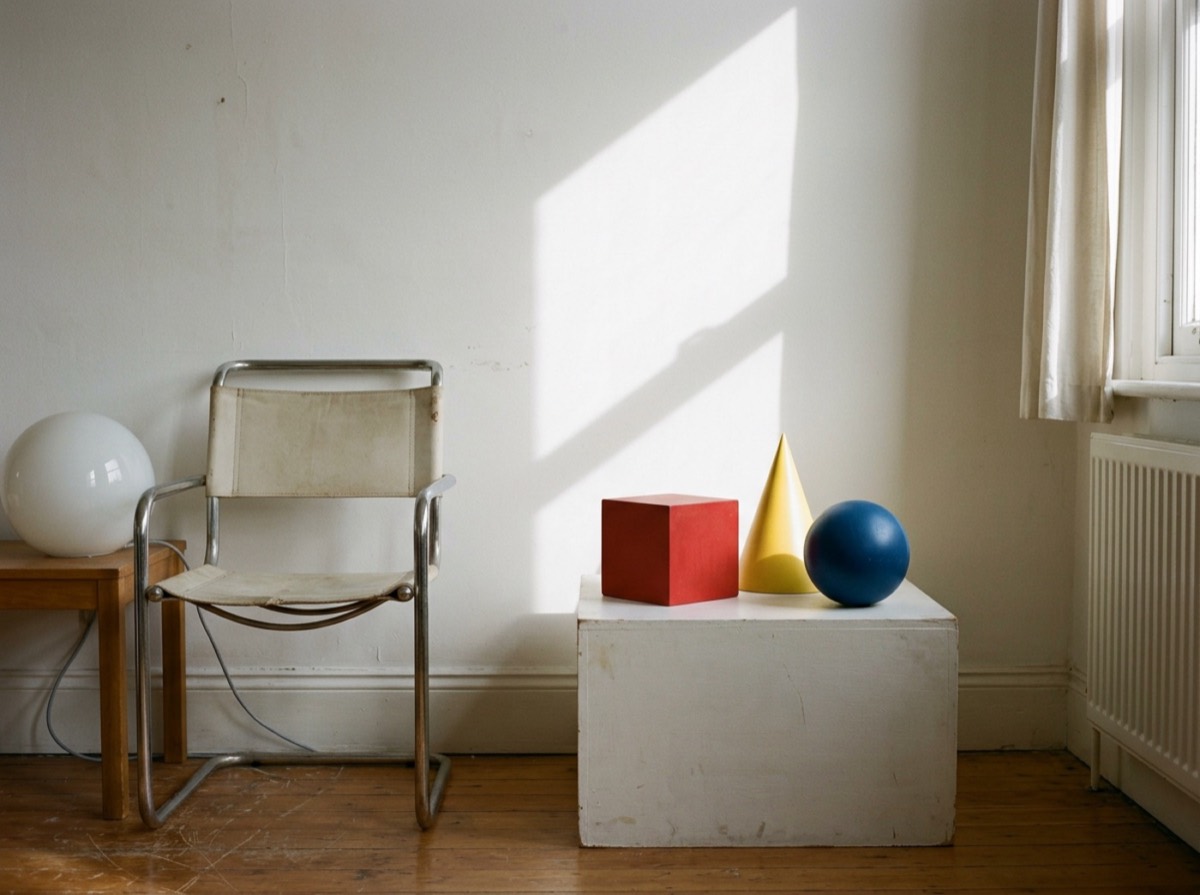
Bauhaus style is easy to spot once you know what to look for. In architecture, look for flat roofs, white or pale rendered walls, cube-like volumes, large windows and asymmetric layouts. In objects, look for clear geometry and industrial materials.
- Circles, squares and triangles as building blocks.
- Primary colours (red, yellow, blue) with black, white and grey.
- Chrome-plated tubular steel, glass and leather in furniture.
- Sans-serif type, grid layouts and strong asymmetry in graphics.
- Open, flexible floor plans and built-in storage in interiors.
- No decorative mouldings, patterns or applied ornament.
How Bauhaus shaped modern design worldwide
When the school closed, many teachers and students emigrated and took their ideas with them. Gropius and Breuer taught at Harvard, Mies van der Rohe led architecture teaching in Chicago, and Moholy-Nagy founded the New Bauhaus in Chicago. Josef and Anni Albers taught at Black Mountain College in North Carolina.
Architects trained in the Bauhaus tradition also helped shape Tel Aviv's White City, a large ensemble of modernist buildings from the 1930s onwards that is now a UNESCO World Heritage Site. Today, the Bauhaus legacy shows up in modernist architecture, minimalist interiors, flat-pack furniture, product design and the clean layouts of modern graphic and digital design.
Bauhaus vs Art Deco: what is the difference?
The two styles developed in the same era but pull in opposite directions. Art Deco is glamorous and decorative, with rich materials, stylised ornament and luxury. Bauhaus is sober and functional, stripping away ornament in favour of simple, useful forms. A useful rule of thumb: if it looks like it belongs in a grand 1920s hotel lobby, it is probably Art Deco; if it looks like a well-organised workshop, it is probably Bauhaus.
Frequently asked questions
What is Bauhaus design in simple terms?
+
Bauhaus design is a modernist approach that combines art, craft and industry to create simple, functional objects and buildings. It favours clean lines, geometric shapes, honest materials and little or no decoration.
Why did the Bauhaus close?
+
The Bauhaus faced constant political hostility, especially from the Nazis. After being forced out of Dessau, it moved to Berlin in 1932, and in 1933, under pressure from the new Nazi regime, the school closed for good.
Where was the Bauhaus located?
+
The school was founded in Weimar in 1919, moved to Dessau in 1925 and relocated to Berlin in 1932. Bauhaus sites in Weimar, Dessau and Bernau are UNESCO World Heritage Sites.
What are the main characteristics of Bauhaus architecture?
+
Typical features include flat roofs, cube-like shapes, smooth pale walls, large windows, asymmetric layouts and materials such as steel, glass and concrete used openly. Ornament is avoided in favour of function.
Did the Bauhaus invent form follows function?
+
No. The phrase is usually credited to the American architect Louis Sullivan, before the Bauhaus existed. The Bauhaus did, however, become closely associated with the idea that function should shape form.
What colours are used in Bauhaus design?
+
Bauhaus graphics and art often use the primary colours red, yellow and blue together with black, white and grey. Interiors and architecture tend towards white and neutral tones with occasional strong accents.
Bauhaus design lasted only fourteen years as a school, but its ideas about function, simplicity and the meeting of art and industry became part of everyday life. From tubular steel chairs to modern apartment blocks and clean digital layouts, the Bauhaus still shapes how things look and work. Once you learn to spot its geometry and restraint, you will see its influence almost everywhere.
How we research: Guides are written from established sources and checked for accuracy. They are general information, not professional advice.
Written by
Bitezine Editorial Team
Rankings, reviews & guides
Our editors research every piece from makers’ documentation, independent tests and owner reports, and update it when products change.