Review · Food & Drink
KitchenAid Artisan stand mixer review: the design icon that still bakes like a workhorse
The KitchenAid Artisan pairs a near-century-old design with planetary mixing, 10 speeds and a universal attachment hub. Is it still the stand mixer to buy in 2026?
 Bitezine Editorial TeamRankings, reviews & guides 7 min read
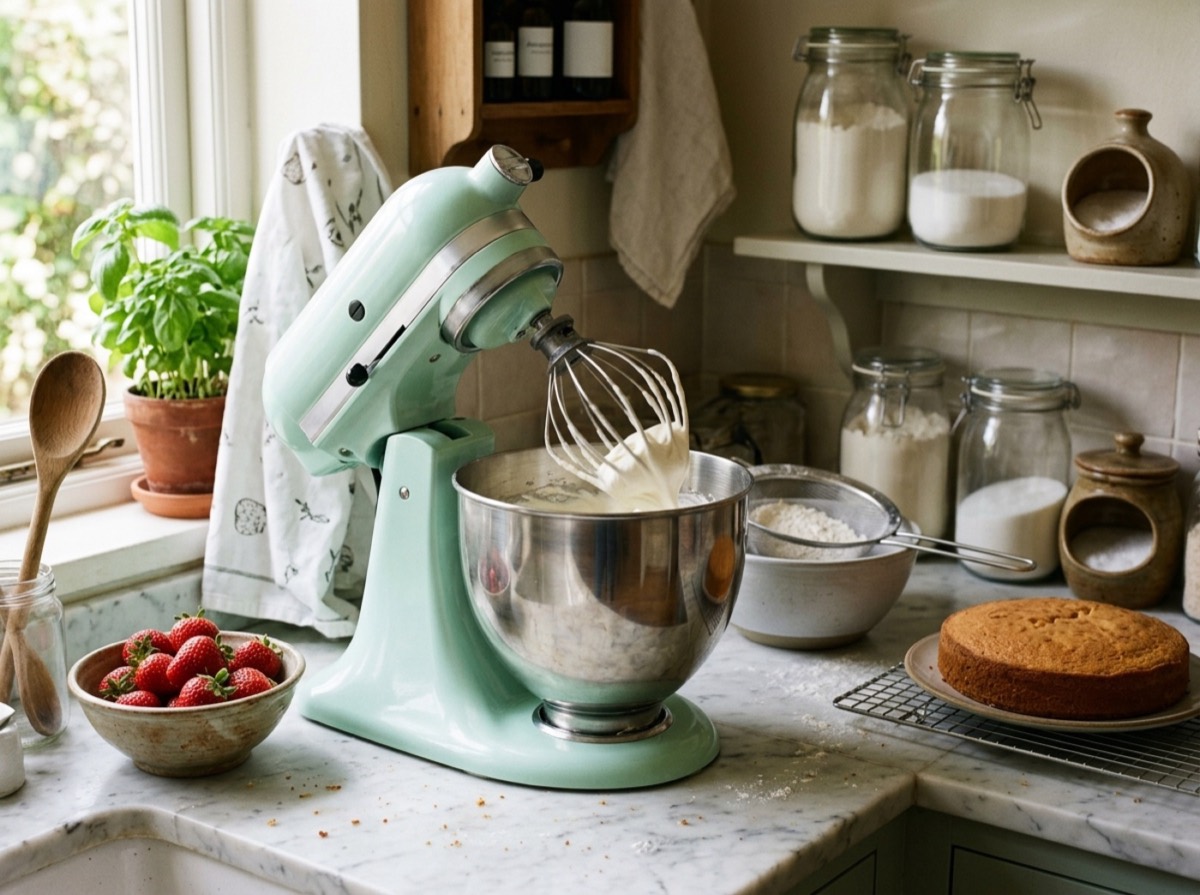 AI generated
 Stand mixer · Premium
KitchenAid Artisan Tilt-Head Stand Mixer (4.8 L, 5KSM185)
The KitchenAid Artisan is a sturdy, beautifully built tilt-head mixer that whips and kneads superbly for most home bakers, though very large or very stiff bread batches push its limits.
What we like
- +Excellent whipping and reliable kneading for everyday batch sizes
- +Planetary mixing action reaches most of the bowl
- +Heavy zinc die-cast body stays put on the counter
- +Attachment hub works with decades of KitchenAid accessories
- +Huge choice of colours and a long manufacturer guarantee
What could be better
- −Modest 300 W rating; stiff doughs can make the motor labour
- −Tilt head can wobble slightly with heavy dough
- −Chunky mix-ins are not always folded in evenly
- −Heavy (around 11 kg), so it tends to live on the counter
- −Wire whisk should be washed by hand
Best for: Home bakers who want a durable, good-looking all-rounder
Visit KitchenAid (Whirlpool Corporation) →Our KitchenAid Artisan stand mixer review looks at one of the most recognisable appliances in any kitchen. The rounded tilt-head silhouette goes back to the Model K that industrial designer Egmont Arens shaped in the 1930s, and KitchenAid still assembles its stand mixers in Greenville, Ohio. In Europe the current Artisan is sold as the 5KSM185 with a 4.8-litre bowl and a 300-watt motor, while the US version is marketed as a 5-quart model.
The question in 2026 is whether a design this old still earns its premium price against newer, more powerful mixers from Kenwood, Bosch and others. Based on the maker's specifications, published lab tests and years of owner reports, the short answer is yes for most home bakers, with a few caveats for people who bake large loaves every week.
Design and build quality
The Artisan's body is die-cast zinc rather than plastic, which is why it weighs around 11 kg according to KitchenAid's European spec sheet. That weight is a practical advantage, because a heavy base helps the mixer stay planted while kneading. The flip side is that it is not something you will want to lift in and out of a cupboard every day.
The tilt head lifts back to give easy access to the bowl, and a lever locks it down for mixing. The bowl twists into the base, and the pouring shield slides on so you can add flour or sugar without a cloud of dust. KitchenAid offers the Artisan in a long list of colours, from classic Empire Red and Onyx Black to seasonal shades, which is a big part of its appeal as a design object.
Key features: planetary mixing, 10 speeds and the attachment hub
Like most quality stand mixers, the Artisan uses planetary mixing: the beater spins in one direction while travelling around the bowl in the other. KitchenAid lists speeds from about 58 to 220 rpm across 10 settings, which covers everything from gently folding in flour to whipping cream at full tilt.
The front attachment hub is the Artisan's secret weapon. KitchenAid has kept the hub compatible across generations since the Model K, so pasta rollers, mincers, spiralisers, grain mills and ice cream bowls all fit. Few rival brands can match the size of that accessory range, and it means the mixer can grow with your cooking.
- Flat beater for cake batters, cookie dough and mashed potatoes
- Dough hook for bread and pizza dough
- Wire whisk for egg whites, meringue and cream
- Optional accessories via the hub: pasta, mincer, vegetable sheet cutter, grain mill and more
Performance: how does the KitchenAid Artisan handle bread dough?
Whipping is where the Artisan shines. TechGearLab gave it a perfect score for whipping and reported stiff peaks in under two minutes, and the tapered bowl shape helps the whisk pick up even small quantities of cream or egg white.
Bread dough is also a strength for normal home batch sizes. In the same lab tests the Artisan developed gluten well in both a high-hydration focaccia and a sandwich loaf. Testers did note that the motor stuttered slightly on the stiffest dough and that the tilt head moved a little under heavy load. KitchenAid's own guide puts the maximum at about 2 kg of bread dough, so if you regularly bake several large loaves at once, a bowl-lift model or a more powerful mixer is a better match.
Beating thick batters with chunky additions such as nuts or chocolate chunks is the weakest area: some reviewers found mix-ins were not spread evenly without a quick scrape or a final stir by hand. For everyday cakes, cookies, brioche and pizza dough, owner reports are overwhelmingly positive.
Cleaning, noise and everyday use
The stainless steel bowl, flat beater and dough hook are dishwasher-safe on the standard Artisan kit, while the wire whisk should be washed by hand to keep it in good shape. Some owners report that coated beaters can chip after years of use, which is why KitchenAid also sells stainless steel versions.
Like any stand mixer it is clearly audible at the top speeds. Controls could hardly be simpler, with a speed lever on the side and the head-lock lever next to it. There is no timer or digital display, which traditionalists like and gadget fans may miss.
Tips for getting the best from a KitchenAid Artisan
A few habits make a noticeable difference with a tilt-head mixer. Always start on the lowest speed when adding flour or icing sugar, then increase gradually once the dry ingredients are incorporated. The pouring shield helps keep the counter clean while you add ingredients.
The gap between the beater and the bottom of the bowl can be adjusted with a small screw near the hinge. If the beater leaves a layer of unmixed ingredients at the bottom, or scrapes the bowl, adjusting this clearance usually solves it. Testers highlighted the adjustable beater height as a real advantage.
For bread, stay within KitchenAid's batch guidance and knead on a low speed. If the motor sounds strained or the head starts to rock, split the dough into two batches. This protects the motor and gives more even kneading.
Who should buy the KitchenAid Artisan?
The Artisan suits keen home bakers who make cakes, cookies, meringues and a loaf or two at a time, and who want an appliance that looks good on show. It is also a strong choice if you plan to add attachments such as a pasta roller or mincer later.
It is less ideal for people who bake large volumes of stiff bread dough several times a week, or for anyone with limited counter space. Those buyers should look at bowl-lift models or mixers with more powerful motors and bigger bowls.
Is the KitchenAid Artisan worth it in 2026?
It sits firmly in the premium bracket, and you can get more wattage for less money from other brands. What you pay for is build quality, a long guarantee, a very large accessory ecosystem and a design that holds its value on the second-hand market. For most home bakers that combination makes the Artisan worth it, as long as your recipes stay within its batch limits.
Key specs
- Power
- 300 W (EU model); 325 W on the US 5-quart version
- Bowl
- 4.8 L stainless steel with handle; many EU bundles add a 3 L bowl
- Speeds
- 10 speeds, roughly 58 to 220 rpm
- Mixing action
- Planetary (tool rotates while orbiting the bowl)
- Included tools
- Flat beater, dough hook, wire whisk, pouring shield
- Maker's batch guide
- Up to about 2 kg bread dough, 2.7 kg cake mix or 12 egg whites
- Size and weight
- About 36 x 24 x 37 cm (H x W x D), around 11 kg
- Guarantee
- 5 years (EU, per KitchenAid)
Alternatives to consider
- Kenwood Chef Titanium Baker: A larger-bowl mixer with a built-in scale for people who bake in bigger batches.
- Bosch MUM Serie 4: A lighter, more affordable mixer that is easier to store for occasional bakers.
- KitchenAid Classic: The same tilt-head design with a slightly smaller bowl and fewer extras at a lower price.
Frequently asked questions
Is the KitchenAid Artisan good for bread dough?
+
Yes, for normal home batches. Lab tests show it kneads both wet and firm doughs well, and KitchenAid rates it for around 2 kg of bread dough. With very stiff or very large batches the motor can labour and the tilt head may move slightly.
How many watts does the KitchenAid Artisan have?
+
The European Artisan 5KSM185 is rated at 300 W, and the US 5-quart version at 325 W. The figure looks low next to some rivals, but lab tests show it still kneads and whips well within its recommended batch sizes.
What is the difference between the KitchenAid Artisan and the Classic?
+
Both are tilt-head mixers with the same attachment hub. The Artisan has a larger bowl with a handle, more colour choices and usually more accessories in the box, while the Classic is a simpler, cheaper model with a smaller bowl.
Are KitchenAid Artisan parts dishwasher safe?
+
The stainless steel bowl, flat beater and dough hook are dishwasher-safe on the standard kit. The wire whisk should be washed by hand, and the motor head should only be wiped clean.
Do old KitchenAid attachments fit the Artisan?
+
Yes. KitchenAid has kept its front attachment hub compatible across generations since the Model K, so older pasta rollers, mincers and other hub attachments fit current Artisan mixers.
How heavy is the KitchenAid Artisan?
+
KitchenAid lists the 4.8-litre Artisan at around 11 kg. The weight keeps it stable while mixing but makes it awkward to move, so most owners keep it on the counter.
KitchenAid Artisan vs Kenwood Chef: which is better?
+
The KitchenAid wins on design, colour choice and attachment range. Kenwood Chef models usually offer more power, larger bowls and extras such as built-in scales, which suits people who bake big batches.
The KitchenAid Artisan stand mixer remains one of the safest buys in home baking. It is not the most powerful mixer you can get, and it is heavy and expensive, but it whips beautifully, kneads everyday doughs reliably and connects to a huge range of attachments. If your baking stays within family-sized batches, the Artisan is worth it in 2026 and should last for many years.
How we research: Reviews are based on the maker’s specifications, published independent tests and owner reports. Scores compare the product with others in its class.
Written by
Bitezine Editorial Team
Rankings, reviews & guides
Our editors research every piece from makers’ documentation, independent tests and owner reports, and update it when products change.