Review · Home & Living
De'Longhi Pinguino GentleJet review: powerful portable air conditioning without the cold blast
De'Longhi's newest Pinguino, the GentleJet, spreads cool air across 180 degrees instead of firing a cold jet. We look at cooling power, noise, efficiency and what's missing.
 Bitezine Editorial TeamRankings, reviews & guides 7 min read
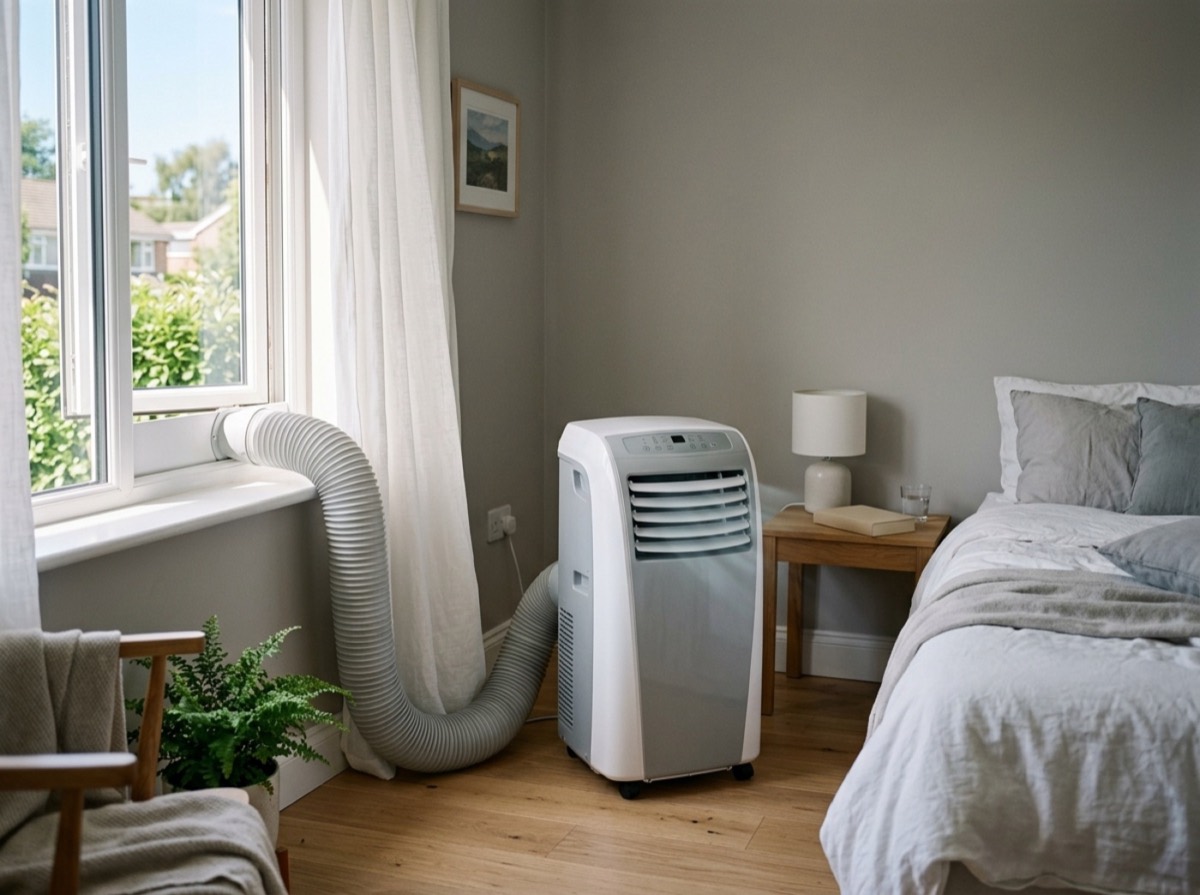 AI generated
 Portable air conditioner · Premium
De'Longhi Pinguino GentleJet Inverter (PACAP130IGENTLEJET)
One of the most pleasant and powerful portable air conditioners you can buy, with draught-free cooling and relatively low noise, but it is pricey and has no app control.
What we like
- +GentleJet spreads cool air across 180 degrees without a cold blast
- +Powerful 13,000 BTU (3.3 kW) cooling for rooms up to 130 m³
- +Inverter modulates power once the room is cool
- +Quieter than many portable units
- +Relatively compact for its power
- +Uses R290 refrigerant, with no water tank to empty
What could be better
- −No Wi-Fi or app control
- −No fabric sealing kit for hinged windows in the box
- −Heavy at around 31 kg
- −Dehumidifying mode cannot target a set humidity
- −Premium price
Best for: Large or hot bedrooms and living rooms
Visit De'Longhi →The De'Longhi Pinguino has been one of Europe's best-known portable air conditioners for decades, and the current flagship is the Pinguino GentleJet. It comes in two versions: the standard GentleJet (PACAP98GENTLEJET) and the more powerful GentleJet Inverter (PACAP130IGENTLEJET). Its signature feature is a mode that spreads cool air across 180 degrees from the top of the unit instead of blasting a cold stream across the room.
This De'Longhi Pinguino review is based on De'Longhi's specifications and independent testing, including a detailed 2026 review by Trusted Reviews. We focus on the Inverter model and point out where the standard GentleJet differs.
Design and setup
For a 13,000 BTU unit, the GentleJet Inverter is relatively slim at 81.4 x 45.7 x 36.3 cm, and independent testers found it smaller than some less powerful Pinguino models. It rolls on castors and has two handles, but at around 31 kg it is not something you will want to carry upstairs often. The design won an iF Design Award in 2025.
Like all single-unit portable air conditioners, it must vent hot air outside through a hose. De'Longhi includes an adjustable window board for sliding and sash windows, a flat nozzle for hinged windows and a through-the-wall kit. What is missing is a fabric seal for tilt-and-turn or casement windows, which are common in Germany; buy one separately for the best results.
A good seal around the hose is the single biggest factor in how well any portable air conditioner performs. Warm outside air leaking back in through a gap forces the unit to work harder and makes the room slower to cool. Keep the exhaust hose as short and straight as possible, and close doors to the room you are cooling.
GentleJet: how it cools
In its default mode, the Pinguino GentleJet pushes cool air out across a 180-degree arc from the top of the unit. The result is a wider, softer breeze that avoids the icy jet many people dislike with portable air conditioners, which makes it particularly pleasant in a bedroom. If you want directed cooling, a traditional motorised louvre opens at the touch of a button and can oscillate.
The Eco Real Feel mode balances temperature and humidity automatically, and De'Longhi claims energy savings of up to 30 percent on the standard model. A Comfort Light indicator shows when the room has reached a comfortable level.
- GentleJet 180-degree diffused airflow
- Optional directed louvre with oscillation
- Eco Real Feel automatic comfort mode
- Cooling, dehumidifying and fan-only modes
Cooling performance and energy use
The Inverter version is rated at 13,000 BTU/h, or 3.3 kW, for rooms up to 130 m³, with an A+ energy class and an EER of 3.2. In independent testing it cooled a loft room from almost 32 °C to 24 °C in about two and a half hours during a heatwave, and a bedroom from 27 °C to 24 °C in 30 minutes.
Because it has an inverter compressor, it doesn't just switch on and off. Once near the target temperature, testers measured power dropping from about 1,035 W to around 465 W, and then to about 10 W in a low-fan monitoring state. De'Longhi claims up to 45 percent energy savings from the inverter. The standard GentleJet has 11,500 BTU/h (2.7 kW) of cooling, also rated A+, with an EER of 3.1.
De'Longhi Pinguino noise level
Portable air conditioners are rarely quiet, but the GentleJet does better than most. De'Longhi lists a sound pressure range of 43 to 50 dB(A) for the Inverter and 41 to 47 dB(A) for the standard model, and says Silent mode is up to 50 percent quieter. An independent measurement at one metre found about 54 dB on maximum cooling, which is similar to a fan on its top setting and not unpleasant.
Dehumidifying, fan mode and controls
Dehumidifying mode removes moisture from the air, and condensate is recycled and expelled through the hose, so there is no tank to empty. However, it runs continuously and cannot be set to a target humidity, so a separate hygrometer is useful. Fan mode works without the hose but is fairly basic.
You control the unit with a touch panel on the front or the included remote, which docks on top. There is a thermostat from 16 to 32 °C, three fan speeds plus auto, and a timer up to 24 hours. There is no Wi-Fi or app, which is the biggest omission at this price, since you cannot pre-cool a room on your way home.
Standard GentleJet vs GentleJet Inverter
Both share the same body, GentleJet airflow, R290 refrigerant and 1.25 m exhaust hose. The Inverter adds more cooling capacity, suits larger rooms and modulates its power, so it is quieter and cheaper to run once the room is cool. The standard model is a good match for bedrooms and smaller living spaces up to about 100 m³, and costs less up front. If your room gets very hot, such as a top-floor flat or loft, the Inverter is worth the extra.
Who should buy the De'Longhi Pinguino GentleJet?
The Pinguino GentleJet suits renters and homeowners who cannot install a split air conditioner but want strong, comfortable cooling for a large or hot room. The draught-free airflow makes it one of the nicer options for sleeping.
If app control or scheduling from your phone matters, or you need to move the unit between floors often, look at lighter smart models. And as with any single-hose portable unit, expect lower efficiency than a fixed split system.
To choose between the two versions, think about room volume rather than floor area. A 20 m² bedroom with a standard 2.5 m ceiling is about 50 m³, well within the standard GentleJet's range. Large living rooms, rooms with big south-facing windows or top-floor rooms under the roof benefit from the extra capacity and inverter control of the 13,000 BTU model.
Key specs
- Cooling capacity
- 13,000 BTU/h, 3.3 kW (Inverter); 11,500 BTU/h, 2.7 kW (standard GentleJet)
- Room size
- Up to 130 m³ (Inverter); about 100 to 110 m³ (standard)
- Energy
- A+ class, EER 3.2 (Inverter), 1,035 W input
- Noise
- 43 to 50 dB(A) sound pressure (Inverter)
- Refrigerant
- R290
- Modes
- Cooling, dehumidifying, fan, Eco Real Feel
- Size and weight
- 81.4 x 45.7 x 36.3 cm, about 31 kg
- Controls
- Front touch panel and remote, 24-hour timer
Alternatives to consider
- De'Longhi Pinguino 100 Silent: A 10,000 BTU Pinguino with Real Feel technology, a Silent mode and a higher listed EER, suited to smaller rooms.
- Midea PortaSplit: A split-style portable unit that keeps the noisy compressor outside, for much quieter and more efficient cooling.
- ProBreeze OmniCool 12,000 BTU: A cheaper alternative that comes with a fabric seal for hinged windows.
Frequently asked questions
Is the De'Longhi Pinguino GentleJet worth it?
+
For large or hot rooms, yes. It cools quickly, spreads air gently without a cold blast and is quieter than many portable units. The main downsides are the premium price and the lack of app control.
How big a room can the De'Longhi Pinguino cool?
+
The GentleJet Inverter is rated for rooms up to 130 m³ with 13,000 BTU/h of cooling. The standard GentleJet, at 11,500 BTU/h, is rated for about 100 to 110 m³.
Does the De'Longhi Pinguino need a window?
+
Yes. Like all single-unit portable air conditioners, it must vent hot air outside through its exhaust hose. It comes with a window board for sliding and sash windows, a nozzle for hinged windows and a wall kit.
Do you need to empty water from the De'Longhi Pinguino?
+
Not in normal use. The GentleJet recycles condensate and pushes it out through the exhaust hose in cooling and dehumidifying modes.
Can you control the Pinguino GentleJet with an app?
+
No. It is controlled with the front touch panel and a remote. There is a timer up to 24 hours, but no Wi-Fi or smartphone app.
How loud is the De'Longhi Pinguino GentleJet?
+
De'Longhi lists 43 to 50 dB(A) for the Inverter model. Independent testing measured about 54 dB at one metre on maximum cooling, which is relatively quiet for a portable air conditioner.
What refrigerant does the De'Longhi Pinguino use?
+
The GentleJet models use R290 (propane), a natural refrigerant with a very low global warming potential compared with older refrigerants.
The De'Longhi Pinguino GentleJet is one of the best portable air conditioners in 2026 for people who want strong cooling without an icy draught. The Inverter version is powerful, efficient for its class and relatively quiet, while the standard model is a good fit for smaller rooms. Missing app control and a hinged-window seal are frustrating at this price, but if comfort matters most, the GentleJet is a premium choice worth considering.
How we research: Reviews are based on the maker’s specifications, published independent tests and owner reports. Scores compare the product with others in its class.
Written by
Bitezine Editorial Team
Rankings, reviews & guides
Our editors research every piece from makers’ documentation, independent tests and owner reports, and update it when products change.