Review · Culture
Catan review: the trading classic after 30 years
Catan brought modern board games to the mainstream. We look at how it plays, the 2025 sixth edition, its luck factor and whether it is still worth buying in 2026.
 Bitezine Editorial TeamRankings, reviews & guides 7 min read
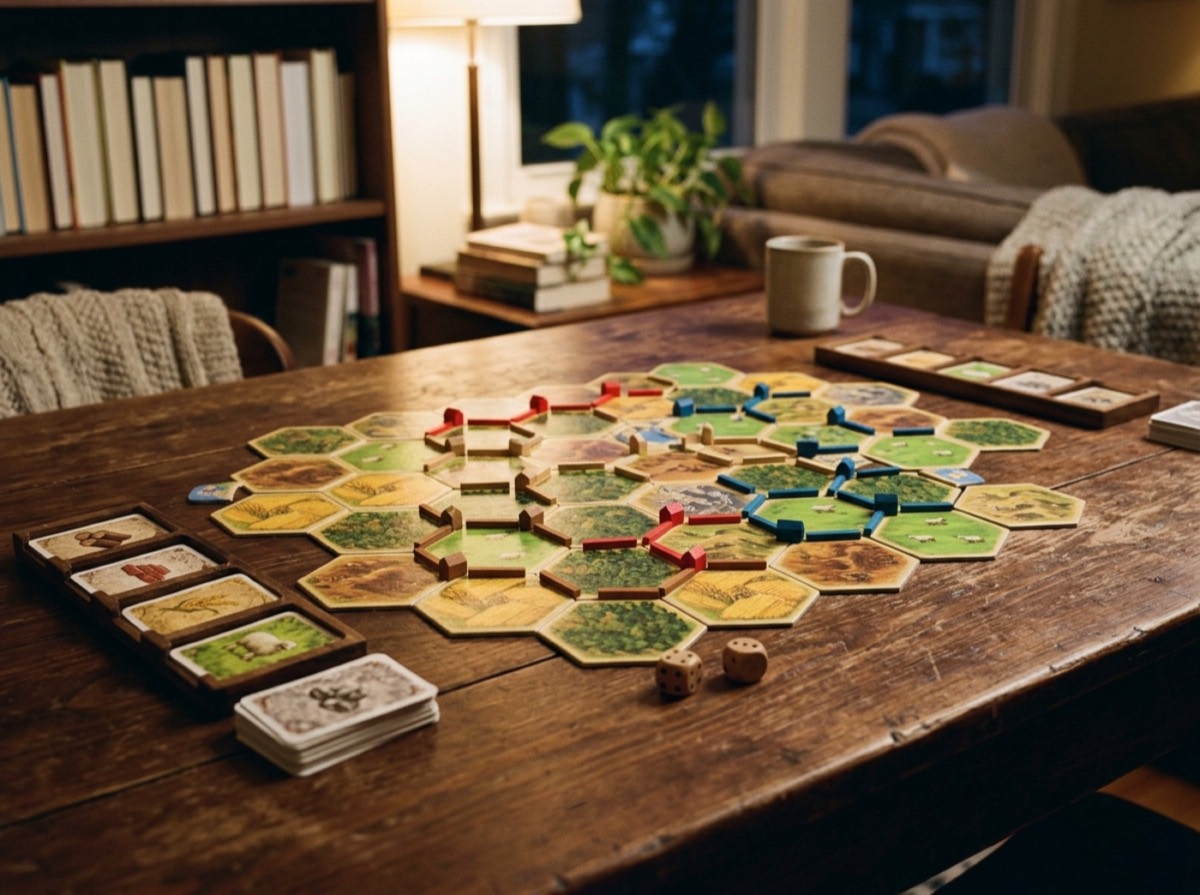 AI generated
 Board game · Mid-range
Catan
Catan is still one of the best games for teaching a group what modern board games can be, as long as you accept that the dice sometimes decide more than your strategy does.
What we like
- +Simple core rules that most people learn in one game
- +Trading keeps every player involved on every turn
- +Modular board makes each game look and play differently
- +Huge range of expansions, extensions and spin-offs
- +Refreshed 2025 sixth edition with updated artwork
What could be better
- −Dice rolls can leave a player starved of resources for long stretches
- −Base game needs at least three players
- −Players who fall behind early rarely catch up
- −Games can run past 90 minutes when trading drags
Best for: Groups of 3 to 4 who enjoy trading and table talk
Visit Catan GmbH / Kosmos →Any Catan review in 2026 has to start with its history. Klaus Teuber's game first came out in Germany in 1995, won the Spiel des Jahres, and went on to sell more than 32 million copies in around 40 languages by 2020. For many people it was the first board game that wasn't Monopoly or Scrabble. In 2025, its 30th anniversary year, the game got a sixth edition with new artwork and packaging, and the big expansions were refreshed to match.
This review draws on the publisher's information, independent board game coverage and years of player feedback. It covers how Catan plays, where it still shines, where it has aged, and whether it is worth buying next to newer family games.
How Catan plays
The board is an island made of hexagonal terrain tiles: forests, hills, mountains, fields, pastures and one desert. Each producing tile gets a number token. At the start of a turn the active player rolls two dice, and every settlement or city next to a tile showing that number collects its resource: lumber, brick, ore, grain or wool.
You spend those resources to build roads, settlements and cities, or to buy development cards. Settlements are worth one point, cities two, and there are bonus points for the longest road and the largest army. The first player to reach 10 victory points on their own turn wins.
Rolling a 7 moves the robber. It blocks a tile's production and lets the roller steal a card, and anyone holding more than seven cards has to discard half. That one rule creates much of the game's tension.
- Roll dice and collect resources
- Trade with other players or the bank
- Build roads, settlements and cities
- Buy and play development cards
Trading: the part that makes Catan special
What sets Catan apart from many newer strategy games is open trading. On your turn you can offer any deal to anyone at the table: two wheat for one ore, a sheep now for a promise later. The bank and harbours give you fixed exchange rates as a fallback, but deals between players are almost always better.
That makes the game social in a way that engine-builders are not. Players stay engaged on other people's turns, alliances form against whoever is in the lead, and a good negotiator can win without the best starting spots. For groups that enjoy talking, this is the heart of the fun. For quieter groups it can feel slow.
The luck problem
The most common complaint about Catan is the dice. Even with smart placement on high-probability numbers such as 6 and 8, a run of unlucky rolls can leave you with nothing for several turns. Experienced players reduce the risk by spreading settlements across different numbers and resources, but they cannot remove it.
The game also has a runaway leader tendency. Players who get a strong start produce more, build more and expand faster. The robber and table politics help a little, but in many games the result is clear well before the end. Some groups use house rules or a card deck in place of dice to smooth the swings.
Sixth edition, expansions and ways to play
The 2025 sixth edition keeps the rules players know and focuses on new artwork and packaging. If you already own the fifth edition, there is little reason to upgrade unless you want the new look. Note that expansions and extensions are generally matched to an edition, so check compatibility before buying add-ons for an older box.
The major expansions are Seafarers, Cities and Knights, Traders and Barbarians, and Explorers and Pirates. Cities and Knights is the favourite of many long-time players because it adds more decisions and reduces the pure dice dependence. The 5 to 6 player extension lets bigger groups join, at the cost of longer games.
Catan also exists as a two-player card game, as travel editions and as digital versions, including Catan Universe and, since July 2025, Board Game Arena. The publisher has also announced a portable ZIP edition and a card game called On the Road for 2026.
Who Catan is for
Catan is a strong choice for families with children aged 10 and up, friend groups that like negotiation, and anyone who wants to try a classic modern board game. It works best with exactly four players.
It is a weaker fit for couples, because the base game does not support two players, and for players who dislike luck. Experienced gamers often find it simple compared with newer titles, although many still enjoy it as a social game.
Is Catan worth it in 2026?
Catan sits in the mid-range price bracket and is easy to find in shops across Europe and North America. For that money you get a game that can be played hundreds of times, thanks to the modular board. Newer gateway games such as Ticket to Ride or Carcassonne are smoother and less swingy, but none of them has the same trading energy.
If your group loves haggling and a bit of drama, Catan is still worth buying. If you want a calmer, more controlled experience, one of the alternatives below may suit you better.
Key specs
- Designer
- Klaus Teuber
- First published
- 1995 (Germany, as Die Siedler von Catan)
- Current edition
- Sixth edition (2025)
- Players
- 3 to 4 (5 to 6 with extension)
- Age
- 10+
- Play time
- 60 to 90 minutes
- Goal
- First to 10 victory points
- Awards
- Spiel des Jahres 1995, Deutscher Spiele Preis 1995
Alternatives to consider
- Ticket to Ride: Simpler rules, less luck and a two-player option make it an easier family pick.
- Carcassonne: A quick tile-laying game that plays well with two and needs no dice.
- Splendor: A short engine-building game with the same build-up feeling and far less randomness.
Frequently asked questions
Is Catan still worth buying in 2026?
+
Yes, for groups that enjoy trading and negotiation. It remains one of the most accessible modern board games, and the 2025 sixth edition refreshed its look. If your group dislikes luck, a game like Ticket to Ride may suit you better.
Can you play Catan with 2 players?
+
The base game is designed for 3 to 4 players, so it does not officially support two. Couples can use fan variants or pick a dedicated two-player version such as the Catan card game for two.
How long does a game of Catan take?
+
The publisher lists 60 to 90 minutes. First games and groups that trade a lot can take longer, especially with the 5 to 6 player extension.
What is the best Catan expansion?
+
Seafarers is the easiest step up because it adds ships and islands without much extra complexity. Cities and Knights is the favourite of many experienced players because it adds depth and reduces the reliance on dice.
What age is Catan suitable for?
+
The official age rating is 10 and up. Younger children who are comfortable with simple maths and trading can often join in with help from an adult.
What changed in the Catan 6th edition?
+
The 2025 sixth edition is mainly a visual refresh with new artwork and packaging, released for the game's 30th anniversary. The core rules are the same, so players of the fifth edition will feel at home.
Catan or Ticket to Ride: which is better for families?
+
Ticket to Ride is usually easier for mixed-age families, plays with two and has less luck. Catan offers more interaction and negotiation, which many older kids and adults love.
Thirty years on, Catan is no longer the most elegant or balanced game on the shelf, but it is still one of the most social. The trading, the robber and the race to 10 points create stories that groups talk about for years. If you want a classic board game for three or four players who like to haggle, Catan is still a very good buy in 2026.
How we research: Reviews are based on the maker’s specifications, published independent tests and owner reports. Scores compare the product with others in its class.
Written by
Bitezine Editorial Team
Rankings, reviews & guides
Our editors research every piece from makers’ documentation, independent tests and owner reports, and update it when products change.