Review · Food & Drink
Breville Barista Express Impress review: the easiest way into real espresso?
Built-in grinder, assisted tamping and PID heating in one box. We weigh whether the Barista Express Impress (Sage in Europe) is worth it in 2026.
 Bitezine Editorial TeamRankings, reviews & guides 7 min read
 AI generated
 Espresso machine · Premium
Breville Barista Express Impress (BES876) / Sage the Barista Express Impress (SES876)
The Barista Express Impress is one of the most forgiving ways to make café-style espresso at home, as long as you accept a mid-grade grinder and a single heating system.
What we like
- +Assisted Impress tamping takes most of the guesswork out of dosing and tamping
- +Integrated conical burr grinder with 25 settings saves buying a separate grinder
- +PID temperature control keeps brew temperature steady
- +Low-pressure pre-infusion helps even extraction
- +Manual steam wand can produce proper microfoam for latte art
What could be better
- −Single thermocoil means a short wait between brewing and steaming
- −Built-in grinder is less precise than a good standalone grinder, especially for light roasts
- −54mm portafilter limits the choice of third-party accessories
- −Large footprint for a small kitchen
Best for: Beginners who want bean-to-cup espresso with hands-on milk steaming
Visit Breville (sold as Sage in the UK and Europe) →The Barista Express has been one of the best-selling home espresso machines for more than a decade, and the Barista Express Impress is its friendlier successor. It keeps the all-in-one formula of grinder, espresso machine and steam wand, then adds a lever-operated tamping system that is meant to fix the step where most beginners go wrong: getting the right dose and an even tamp. In the UK and Europe the same machine is sold by Sage as the Barista Express Impress.
Based on Breville's specifications, published reviews and a large base of owner reports, this review looks at what the Impress system really changes, how good the espresso and milk can be, and whether it is worth paying extra over the classic Barista Express in 2026.
Design and build quality
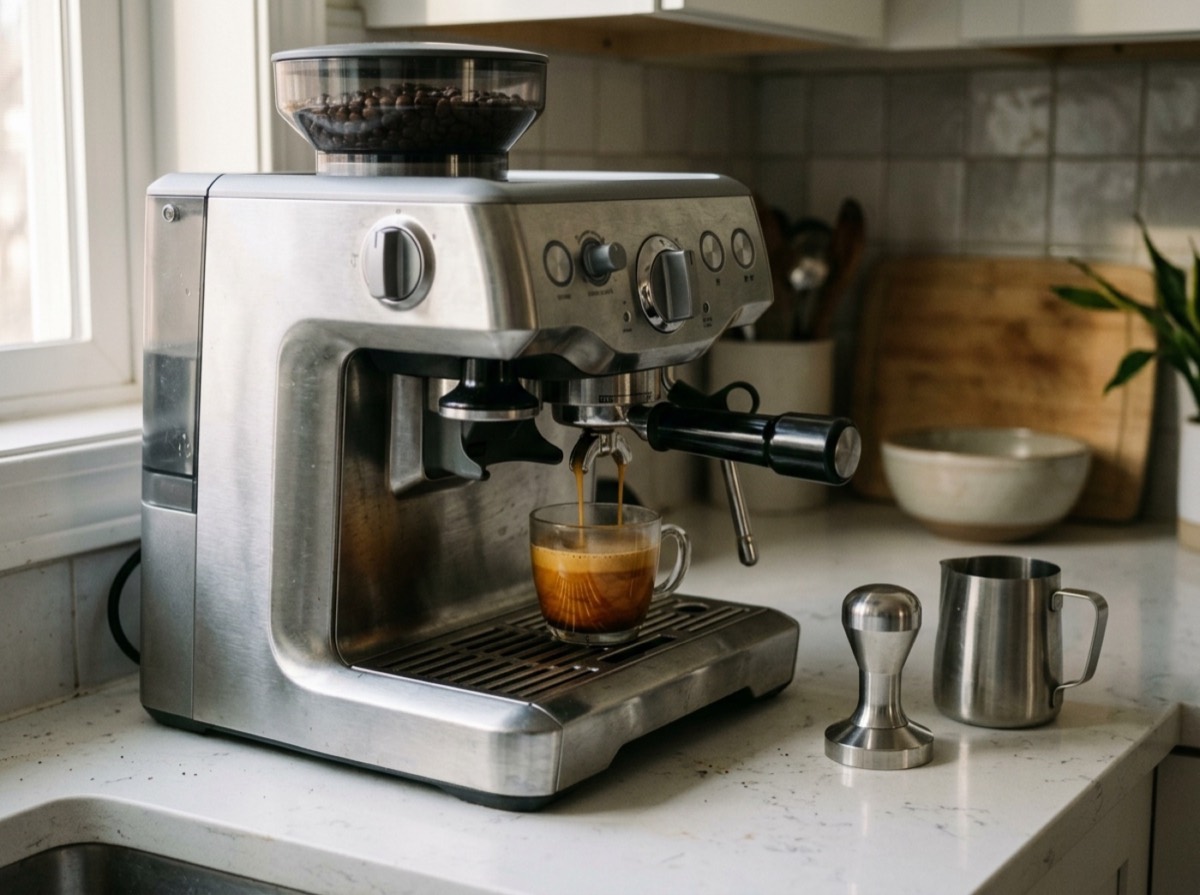
The Impress looks much like the rest of Breville's Barista range: brushed stainless steel, a bean hopper on top, a pressure gauge on the front and a steam wand on the right. The main visual difference is the tamping lever on the left side of the group head, which you pull down after grinding to compress the coffee.
It is a substantial machine, roughly 42 cm wide including the lever and about 37 cm deep, so measure the space under your cabinets. Build quality is generally described as solid for the price, though the drip tray and some trim parts are plastic. The 54mm portafilter is lighter than the commercial-style 58mm handles on machines such as the Gaggia Classic.
How the Impress puck system works
After the grinder fills the portafilter, you pull the lever. The machine applies a consistent tamp of roughly 10 kg and adds a small twist to polish the surface of the puck. A display then tells you whether the dose was too low, right or too high, and the machine adjusts the next grind amount automatically. This feedback loop is the heart of the Impress: reviewers consistently note that it makes it far easier to get repeatable shots than on the standard Barista Express, where dosing is done by eye.
The system is also cleaner. Because the grounds are compressed in place, less coffee ends up on the counter, which is a common complaint with manual tamping.
- Grind directly into the portafilter
- Pull the lever to tamp and read the dose indicator
- Machine corrects the dose on the next grind
- Lock in and brew with pre-infusion
Espresso quality and grinder performance
Breville uses PID control to hold the brewing water near 93°C and starts each shot with low-pressure pre-infusion before ramping up. Together these features help the machine produce balanced shots with medium and dark roasts, and owner reports suggest it is capable of genuinely good espresso once the grind is dialled in.
The limiting factor is the grinder. Twenty-five steps is a narrow range for espresso, and some reviewers found it hard to go fine enough for very light roasts or very fresh beans. Breville allows the inner burr to be adjusted to shift the range, which helps, but coffee enthusiasts who plan to experiment widely often end up adding a separate grinder.
Milk steaming
The manual steam wand is the same style used across the Barista line. It is capable of silky microfoam for flat whites and latte art, but it is not as powerful as a dual-boiler or ThermoJet machine, so steaming a large jug takes a little longer. Because one thermocoil handles both jobs, there is a short pause while the machine switches from brewing to steaming temperature.
For one or two milk drinks at a time this is barely noticeable. If you regularly make four or more lattes in a row, a machine with faster steam, such as the Barista Pro or a dual boiler, will feel quicker.
Barista Express Impress vs Barista Express vs Barista Pro
The classic Barista Express is cheaper and very similar in hardware, but you dose and tamp manually. The Barista Pro adds a faster ThermoJet heating system, a digital display and a grinder with more steps, but it has no assisted tamping. The Impress sits between the two: it is the best choice if your priority is consistency with minimal learning, while the Pro suits people who want speed and more grind control.
Who should buy it?
The Impress is aimed at people moving from pods or a capsule machine who want real espresso without buying a separate grinder, scale and tamper. It is also a good fit for households where several people make coffee, since the assisted tamp reduces variation between users.
It is less suited to experienced home baristas who want to fine-tune every variable, or to people who drink mostly light, Nordic-style roasts.
Is the Barista Express Impress worth it?
It sits in the premium price bracket for home machines, and you are paying for convenience as much as hardware. Compared with buying an entry-level espresso machine plus a capable grinder, the Impress is competitively priced and much easier to live with. Regular descaling and cleaning are needed, as with any espresso machine, and the grinder burrs will eventually need replacing on heavily used units.
Key specs
- Grinder
- Integrated conical burr, 25 grind settings
- Tamping
- Impress assisted tamp (approx. 10 kg / 22 lb with a 7° twist)
- Heating
- Thermocoil with PID temperature control
- Pump
- 15-bar Italian pump, low-pressure pre-infusion
- Portafilter
- 54mm stainless steel, single- and dual-wall baskets
- Water tank
- Approx. 2 litres
- Dimensions
- Approx. 42 x 37 x 31 cm (16.6 x 14.4 x 12.2 in)
Alternatives to consider
- Breville Barista Pro: Faster heat-up and steaming plus a finer-stepped grinder, but manual tamping.
- Gaggia Classic E24: A simpler, more repairable machine with a 58mm portafilter, if you already own a good grinder.
- De'Longhi La Specialista Arte Evo: Another grinder-equipped machine with a tamping aid and a strong steam wand.
Frequently asked questions
Is the Breville Barista Express Impress good for beginners?
+
Yes. The assisted tamping and dose feedback remove two of the hardest skills for new users. You still need to adjust the grind size when you change beans, but the machine gives clear guidance.
What is the difference between Breville and Sage Barista Express Impress?
+
They are the same machine. Breville sells it in North America and Australia, while in the UK and much of Europe it is branded Sage for trademark reasons. Plugs and voltages differ by region.
Can the Barista Express Impress make light roast espresso?
+
It can, but owners report that the built-in grinder can struggle to grind fine enough for some light roasts. Adjusting the upper burr helps, and some users pair the machine with a separate grinder.
How long does it take to heat up?
+
The thermocoil heats up much faster than a traditional boiler, so it is ready in well under a minute according to most reports. There is a brief additional wait when switching to steam.
Does the Barista Express Impress have a water filter?
+
Yes, it uses a replaceable filter in the water tank, which Breville recommends changing regularly to reduce scale. Descaling is still required based on your water hardness.
Barista Express Impress vs Barista Touch Impress: which should I buy?
+
The Touch Impress adds a touchscreen and automatic milk texturing. If you want to learn manual steaming, the Express Impress is the better value; if you want push-button lattes, consider the Touch version.
The Breville (or Sage) Barista Express Impress makes the jump into proper espresso far less intimidating. Its assisted tamping and dose feedback deliver more consistent shots than the original Barista Express, and the PID and steam wand are good enough for café-style drinks. Enthusiasts may outgrow the grinder, but for most home coffee drinkers who want one machine that does it all, it remains one of the safest buys in 2026.
How we research: Reviews are based on the maker’s specifications, published independent tests and owner reports. Scores compare the product with others in its class.
Written by
Bitezine Editorial Team
Rankings, reviews & guides
Our editors research every piece from makers’ documentation, independent tests and owner reports, and update it when products change.