Money
How to save money on groceries without eating worse
Practical ways to save money on groceries: plan meals, shop with a list, compare unit prices, choose store brands and waste less food, without giving up good meals.
 Bitezine Editorial TeamRankings, reviews & guides 6 min read
 AI generated
Learning how to save money on groceries is one of the quickest ways to free up cash, because food is a large, flexible part of most household budgets. Unlike rent, you decide what goes into the trolley every single week.
The good news is that the biggest savings rarely come from extreme couponing or eating plain rice. They come from planning, comparing prices properly and throwing away less. The tips below are general information, not financial advice; pick the ones that fit your household.
Start with a grocery budget
You cannot cut a bill you have not measured. Look back over the last two or three months of receipts or bank statements and add up everything spent on food, including snacks, takeaway coffee and quick top-up shops. Most people are surprised by the total.
Set a weekly or monthly grocery budget a little below that figure, then check your progress each week. A clear number turns vague intentions into decisions at the shelf.
Plan meals before you shop
Meal planning is the single most effective habit for a lower food bill. When you know what you will cook, you buy only what those meals need, and you are less likely to order takeaway on a tired evening.
Plan around what you already have. Check the fridge, freezer and cupboard first, then choose meals that use those ingredients before they spoil. Pick recipes that share ingredients, so half a bunch of herbs or a tub of yoghurt gets used across several dishes.
- Plan five or six dinners and leave one night for leftovers.
- Cook double portions of soups, stews and sauces and freeze the rest.
- Plan lunches too, since bought lunches add up quickly.
- Rotate a set of reliable, low-cost meals so planning takes minutes.
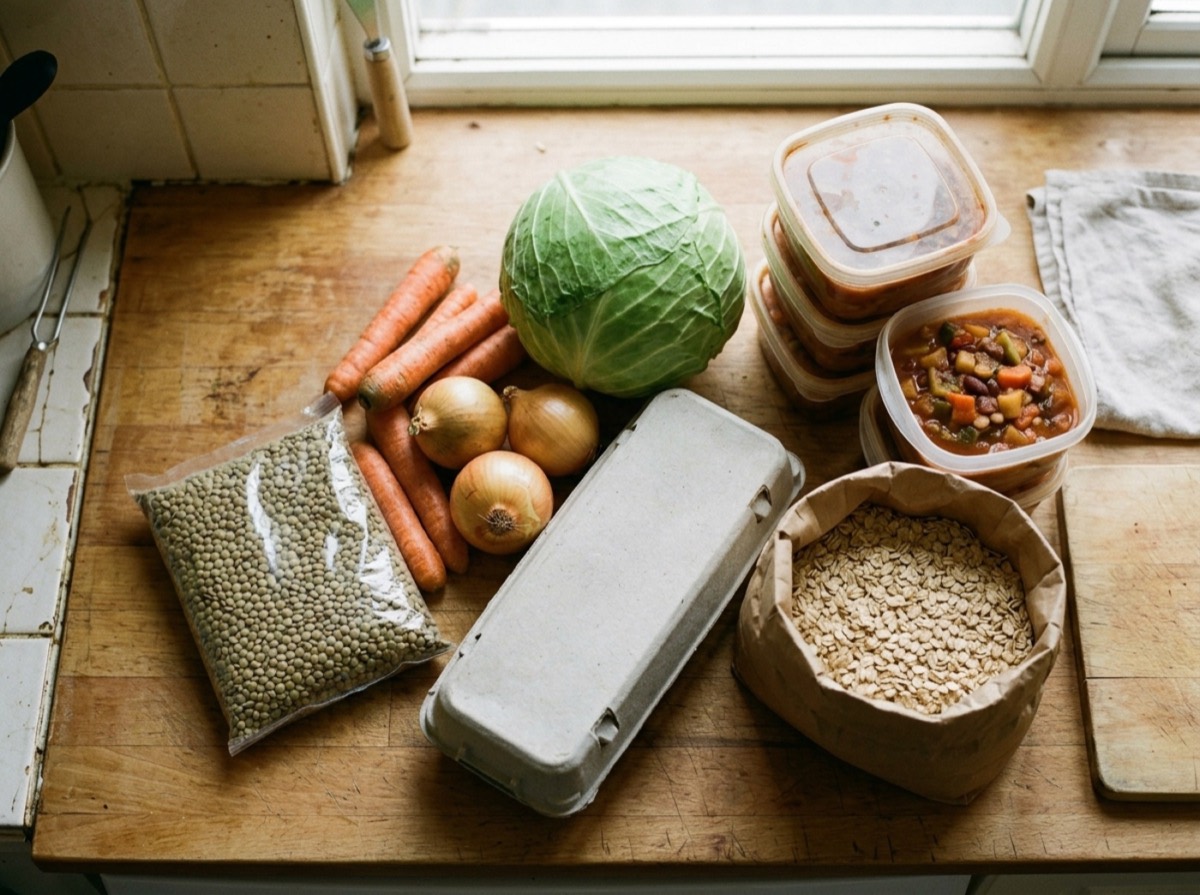
The biggest grocery savings come from planning, not from eating plain rice.
Shop with a list and stick to it
Shops are designed to make you buy more than you planned. End-of-aisle displays, multi-buy offers and treats at the checkout all work on impulse. A written list, organised by the layout of your usual shop, keeps you focused and speeds up the trip.
Shopping less often also helps. Every extra visit is another chance for impulse buys, so one planned weekly shop with a short top-up for fresh produce usually beats daily trips. And avoid shopping hungry: it reliably increases what ends up in the basket.
Compare unit prices, not pack prices
The shelf price tells you what a pack costs, but the unit price tells you what the food costs, per kilo, per litre or per piece. In the EU, shops are generally required to display the unit price next to the selling price, which makes fair comparisons easy once you get into the habit.
Unit prices reveal when the big pack is not the bargain it seems, when a special offer is smaller than the usual size, and when loose vegetables are cheaper than pre-packed ones. Look at the top and bottom shelves too; the most expensive products are often placed at eye level.
Store brands vs name brands
Switching to supermarket own brands is one of the easiest ways to cut a grocery bill. For basics such as flour, sugar, pasta, rice, tinned tomatoes, milk and cleaning products, the difference in quality is often small or nonexistent, while the price gap can be large.
Try a switch one product at a time. If your household genuinely prefers a branded version of something, keep it and save on the rest. Reading the ingredient list side by side is a good way to see how similar two products really are.
More ways to cut your food bill
Once the basics are in place, these habits add further savings without making meals less enjoyable.
- Buy fruit and vegetables in season, when they are cheaper and taste better.
- Use frozen vegetables and fruit: they are picked ripe, keep for months and cause no waste.
- Eat less meat or use it as a flavouring, with beans, lentils and eggs as affordable protein.
- Buy staples in bulk only if you will use them before they go off and have space to store them.
- Check reduced-price shelves near closing time and freeze what you cannot eat soon.
- Compare shops: discount supermarkets and markets can be much cheaper for basics.
- Use loyalty schemes for things you already buy, not as a reason to buy more.
- Bring snacks and a water bottle when you go out to avoid expensive convenience food.
- Cook from scratch more often; ready meals and pre-cut produce carry a large markup.
How to reduce food waste and save money
Wasted food is money in the bin. According to the UN Environment Programme's Food Waste Index Report 2021, households are responsible for the majority of food waste worldwide, about 61 percent of the total. Cutting your own share is a direct saving.
Understanding date labels helps. In the EU, a "use by" date is about safety and should be respected, while a "best before" date is about quality: many foods are still fine after it if they look, smell and taste normal and have been stored correctly.
- Store food properly: learn which produce belongs in the fridge and which does not.
- Move older items to the front of the fridge and cupboard.
- Freeze bread, leftovers and ripe bananas before they turn.
- Keep a "use first" box in the fridge for opened and nearly expiring food.
- Turn leftovers into soups, frittatas, fried rice or pasta sauces.
Frequently asked questions
What is the fastest way to save money on groceries?
+
Plan your meals for the week, shop with a list and switch basics to store brands. Those three changes usually cut a food bill noticeably within the first month, without changing what you eat very much.
How much should I spend on groceries?
+
There is no single right number, because it depends on household size, local prices and dietary needs. Start by tracking what you spend now for a few weeks, then set a budget slightly below that and adjust as you learn.
Are store brands as good as name brands?
+
For many staples, such as pasta, rice, flour, tinned goods and cleaning products, store brands are very similar in quality. Compare ingredient lists and try one product at a time to see which switches your household is happy with.
Is it cheaper to buy groceries in bulk?
+
Often, but only for items you use regularly and can store before they spoil. Check the unit price, because larger packs are not always cheaper, and bulk buying perishables can simply lead to more waste.
Can I eat food after the best before date?
+
A best before date is a quality indicator, so many foods are still safe afterwards if stored correctly and they look, smell and taste normal. A use by date is about safety, and food should not be eaten after it.
Is frozen food cheaper than fresh?
+
Frozen vegetables and fruit are often cheaper than fresh, especially out of season, and they last for months, which cuts waste. Nutritionally they hold up well because they are usually frozen soon after harvest.
Saving money on groceries comes down to a few steady habits: know your budget, plan meals, shop with a list, compare unit prices and waste less. None of them requires eating worse. Start with one or two changes this week, watch the receipts shrink and add more as they become routine.
How we research: Guides are written from established sources and checked for accuracy. They are general information, not professional advice.
Written by
Bitezine Editorial Team
Rankings, reviews & guides
Our editors research every piece from makers’ documentation, independent tests and owner reports, and update it when products change.